Thursday, March 10, 2005


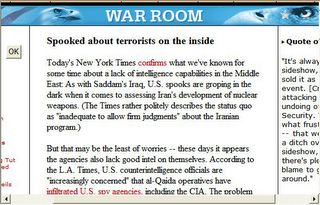
Spooked about terrorists on the inside

Today's New York Times confirms < http://www.nytimes.com/2005/03/09/international/09weapons.html?hp&ex=1110430800&en=48649e4ca2d8893d&ei=5094&partner=homepage> what we've known for some time about a lack of intelligence capabilities in the Middle East: As with Saddam's Iraq, U.S. spooks are groping in the dark when it comes to assessing Iran's development of nuclear weapons. (The Times rather politely describes the status quo as "inadequate to allow firm judgments" about the Iranian program.)
But that may be the least of worries -- these days it appears the agencies also lack good intel on themselves. According to the L.A. Times, U.S. counterintelligence officials are "increasingly concerned" that al-Qaida operatives have infiltrated U.S. spy agencies, including the CIA. The problem traces directly to two long-running deficiencies: a critical shortage of American intelligence officers skilled in foreign languages, and a dearth of human intelligence assets in key foreign regions.
"So far, about 40 Americans who sought positions at U.S. intelligence agencies have been red-flagged and turned away for possible ties to terrorist groups," said counterintelligence officials, according to the L.A. Times. That number includes "several applicants" detected at the CIA.
"Fear of possible penetration has grown because of what one official called 'an intense competition' among America's intelligence, military and contractor organizations. They are seeking to hire thousands of skilled linguists, trained analysts and clandestine operatives who can blend into overseas communities to collect intelligence and to recruit foreign agents inside terrorist cells.
"In some cases, the officials said, those most qualified for such sensitive jobs -- naturalized Americans who grew up in the Middle East or South Asia, for example, and who are native speakers of Arabic, Farsi, Dari, Urdu and other crucial languages -- have proved the most difficult to vet during background checks. In addition, because of restrictions imposed by U.S. privacy laws, authorities at one spy service may not know that someone they had rejected later found a job at another agency or at a defense contractor working on classified systems."
Perhaps privacy laws are part of the problem, but what about the ongoing bureaucratic mess < http://www.salon.com/politics/war_room/2005/03/07/hsd/index.html> that is the Bush administration's Department of Homeland Security? It seems the administration's reorganization of the intelligence apparatus into one super-agency hasn't done much to improve efficiency; various agencies still rely on outsourcing for vetting recruits. "With vast increases in funding from Congress after the 2001 attacks, " the L.A. Times report continues, "the 15 U.S. intelligence agencies launched sweeping recruitment programs. Most have been deluged with thousands of resumes and job applications, forcing several spy services to contract background checks to private firms.
"Paul Redmond, a longtime CIA officer who works for the counterintelligence office, called it an 'actuarial certainty' that spies have infiltrated U.S. security agencies. He warned that, because of efforts since Sept. 11 to more widely share critical intelligence as part of broader reforms, the danger of espionage was growing. 'I think we're worse off than we've ever been,' he said."
There are a couple other striking segments in the report, drawn from a national conference on counterintelligence held last weekend at Texas A&M University. For one, the threat of infiltration isn't only from Islamic extremists, and isn't limited to the government sector. Lisa Bronson, the undersecretary of defense in charge of vetting exports of defense-related materials, told conference goers that "2,000 to 3,000 front companies" inside America are working to obtain so-called dual-use civilian equipment or information that could be used to help China's military.
And there were some rather intriguing comments made by the first President Bush, who served as CIA chief in the late 1970s.
"George H.W. Bush, whose presidential library is at Texas A&M, opened the weekend conference with a fervent defense of the CIA. Bush said it 'burns me up to see the agency under fire' for flawed intelligence on prewar Iraq."
The White House blame game has burned up a number of other folks , too. Maybe Bush the senior should have a heart-to-heart with junior about what else is really behind the various U.S. intelligence disasters < http://www.salon.com/news/feature/2004/06/14/coup/> of the last several years.
-- Mark Follman

Murder by Off-Duty Homeland Security Agent

PBU11 (Technorati Tag)
Amazing Murder related to Homeland Security Off-Duty Officer
http://www.justiceforbassim.com

3/11/2004 Update:


--------------------------------------------------------------------------------

http://www.latimes.com/news/local/la-me-bassim11mar11,1,4809421.story

Grand Jury to Probe Killing
An off-duty federal officer shot a man during a fight at a Mission Viejo party, and the district attorney wants sworn testimony.
By H.G. Reza
Times Staff Writer

March 11, 2005

The Orange County Grand Jury will begin hearing testimony today on the shooting death of a 20-year-old man last month by an off-duty federal officer during a confrontation at a noisy party, Dist. Atty. Tony Rackauckas said.

Sheriff's officials said U.S. Customs and Border Protection Officer Douglas Bates killed Bassim Chmait with a single shot to the head during an altercation Feb. 5 at a Mission Viejo apartment complex. Authorities said Bates, who lives in the complex, got into a fight with Chmait, of Laguna Hills, and four to six of Chmait's companions as they arrived at the party about 1:30 a.m.

The initial report of the incident by the Sheriff's Department said Bates came out of his apartment because he heard a disturbance and that his duty weapon discharged, perhaps accidentally.

The victim's brother, Omar Chmait, challenged the official version. Omar Chmait was not present, but he has said that witnesses, who were friends of the victim, contended that Bates had provoked the fight.

Law enforcement officials familiar with the investigation said several witnesses gave contradictory accounts of the shooting. On Thursday, Rackauckas said the grand jury would sort through the testimony and decide whether to indict Bates.

"There might be some credibility questions, and we want to lay all of that information out to the grand jury so they can make whatever credibility decisions need to be made," Rackauckas said. He expects the grand jury probe to be completed in two to three weeks.

Sheriff's detectives finished their investigation last week and forwarded their findings to the district attorney. Normally, prosecutors review such reports and decide whether the evidence warrants charges. But Rackauckas said his office and the Sheriff's Department decided it would be better to let the grand jury hear the facts and make a decision.

"It's a case where we think we need testimony under oath," he said. "There's further investigation to do. The grand jury is an investigative body, and we want the testimony of a number of people who could be witnesses."

He declined to say whether the grand jury was impaneled to hear the case because investigators were having problems getting key witnesses to talk to them, as some law enforcement officials have said.

"But it's certainly our intention to have [testimony from] everyone who might be a witness to any relevant part of what happened," Rackauckas said.

It was also learned Thursday that sheriff's investigators had summoned a deputy district attorney to the scene the night of the shooting when they discovered that the shooter was a law enforcement officer. "We have had a deputy district attorney [involved in the investigation], starting right away," Rackauckas said.

Chmait's family and friends have held weekly vigils outside the Madrid Apartments, in the 2800 block of Los Alisos Boulevard, calling for Bates' arrest. About three weeks ago, the family also organized a demonstration outside Rackauckas' office to press for the prosecution of Bates.

On Thursday, the victim's uncle, Hikmat Chmait of Irvine, expressed relief on behalf of the family.

"This gives us hope that maybe justice will be served," he said. Initially discouraged by what they perceived as the reluctance of authorities to pursue the case, Chmait said, the family was "feeling better" knowing that the evidence would be presented to the grand jury.

"We won't feel good, though," he said, until the family hears that Bates will be prosecuted. "I hope the prosecution prevails."

Rackauckas said he understood the family's concerns, but said prosecutors and the grand jury would make decisions based on the merits of the case.

*


--------------------------------------------------------------------------------
Times staff writer David Haldane contributed to this report.


--------------------------------------------------------------------------------

If you want other stories on this topic, search the Archives at latimes.com/archives.

Article licensing and reprint options


Copyright 2005 Los Angeles Times

Review of Book: 911 on Trial

Is Bush looking for Osama?


Secret FBI Report Questions Al Qaeda Capabilities
No 'True' Al Qaeda Sleeper Agents Have Been Found in U.S.
Mar. 9, 2005 - A secret FBI report obtained by ABC News concludes that while there is no doubt al Qaeda wants to hit the United States, its capability to do so is unclear.
"Al-Qa'ida leadership's intention to attack the United States is not in question," the report reads. (All spellings are as rendered in the original report.) "However, their capability to do so is unclear, particularly in regard to 'spectacular' operations. We believe al-Qa'ida's capability to launch attacks within the United States is dependent on its ability to infiltrate and maintain operatives in the United States."
And for all the worry about Osama bin Laden's sleeper cells or agents in the United States, a secret FBI assessment concludes it knows of none.
The 32-page assessment says flatly, "To date, we have not identified any true 'sleeper' agents in the US," seemingly contradicting the "sleeper cell" description prosecutors assigned to seven men in Lackawanna, N.Y., in 2002.
Overblown Sleeper Cell Threat?
"Limited reporting since March indicates al-Qa'ida has sought to recruit and train individuals to conduct attacks in the United States, but is inconclusive as to whether they have succeeded in placing operatives in this country," the report reads. "US Government efforts to date also have not revealed evidence of concealed cells or networks acting in the homeland as sleepers."
It also differs from testimony given by FBI Director Robert Mueller, who warned in the past that several sleeper cells were probably in place.
"Our greatest threat is from al Qaeda cells in the United States that we have not yet been able to identify," Mueller said at a Senate Select Intelligence Committee hearing in February 2003. "Finding and rooting out al Qaeda members once they have entered the United States and have had time to establish themselves is our most serious intelligence and law enforcement challenge."
When the secret report was issued last month, on Feb. 16, Mueller testified at a hearing before the same committee that the lack of evidence concerned him. "I am concerned about what we are not seeing," he said.
The report does cite several cases in which individuals have been seen as potential sleeper agents, including a member of the Saudi Arabian Air Force training at Lackland Air Force Base in Texas.
The Saudi was sent home after it was discovered he provided information to al Qaeda figures in Saudi Arabia, including "coordinates on landmarks in the US," the report says.
"It's not surprising because we believe the Saudi military is infiltrated at the junior officer level in Saudi Arabia," said Dick Clarke, a former White House counterterrorism czar and now an ABC News Consultant. "And there are so many of them who come here for training."
New Al Qaeda Recruits
The report also says al Qaeda is shifting tactics because its leaders are aware of profiles singling out adult Arab males.
"Al-Qa'ida places a premium on operatives who are not, or at least appear not to be, Arab, particularly those with European or Asian features, according to various detainee reporting," the report reads. "Detainees also report that al-Qa'ida is interested in recruiting US citizens to participate in US operations, particularly African-American converts to Islam."
But the report continues that "US recruits are hard to find and al-Qa'ida detainees have reported that US citizens can be difficult to work with, one senior detainee claimed that US citizens and others who grew up in the West, were too independent and thought they knew more about US operations than senior planners."
In addition, women and married couples with children are being actively recruited, according to the report.
"A senior al-Qa'ida detainee instructed an operative who is currently in US custody, to settle in the United States with his family and maintain a low profile before eventually conducting an attack," the report reads. "Al-Qa'ida operatives have also married US women to obtain US visas and foreign documentation from other countries, according to sensitive reporting."
No Solace in No Evidence
The FBI says it takes no solace in the lack of evidence, or about what it is not seeing.
"Individual operatives who possess a clean passport, have not come to the attention of intelligence agencies overseas, and lack a criminal record are unlikely to attract the attention of security agencies in the United States, unless they are in contact with known extremists," according to the report. "Al-Qa'ida has altered its operative profile, making it more difficult to screen visa applicants at embassies and individuals entering the United States at airports and other border crossings."
And the report suggests that instead of actual sleeper agents, lying in wait, al Qaeda may rely on disaffected Americans or other sympathizers, who might pick easier, softer targets such as shopping malls.
Clarke warned, "We have reason to believe that techniques like that and others we shouldn't talk about are well known to terrorists around the world."
ABC News' David Scott contributed to this report.
Copyright © 2005 ABC News Internet Ventures


washingtonpost.com /* start correction */ .correction { margin-top:8px; border-top:1px solid #CCCCCC; padding-top:10px; margin-bottom:8px; border-bottom:1px solid #CCCCCC; padding-bottom:10px; font-family:arial,sans-serif; font-size:11px; color:#5A5A5A; } .correction strong { color:#CC0000; text-transform:uppercase; } /* end correction */
9/11 Panel's Findings Strain German Case
By Craig Whitlock
Washington Post Foreign Service
Wednesday, March 9, 2005; Page A12
HAMBURG, March 8 -- An attorney for the Sept. 11 commission testified Tuesday that the conspiracy to fly hijacked airplanes into the World Trade Center and the Pentagon was conceived and planned outside Germany, complicating prosecutors' efforts to convict a Moroccan man for aiding the Hamburg cell that carried out the attacks.
Dietrich Snell, who headed the commission's team that investigated the origins and role of the Hamburg cell, told a panel of five German judges hearing the case that the ringleader, Mohamed Atta, and the other Sept. 11 hijackers did not develop the idea for the plot on their own. Rather, Snell testified, they were recruited by al Qaeda chief Osama bin Laden during a visit to militant training camps in Afghanistan.
"This is a subject that we spent considerable time investigating," Snell said. "Ultimately, we did not arrive at the conclusion that there was solid evidence of any contact" between Hamburg cell members and al Qaeda leaders about the plot before the Hamburg group's trip to Afghanistan.
The commission's findings contradict the heart of Germany's case against the Moroccan defendant, Mounir Motassadeq, who is accused of more than 3,000 counts of accessory to murder and membership in a terrorist organization.
Prosecutors must prove that important elements of the conspiracy took place in Germany. Before Sept. 11, 2001, it was legal in Germany to belong to a foreign terrorist organization such as al Qaeda as long as it was not active in the country.
Motassadeq, a college student in Hamburg before the attacks, was a close friend of Atta's and others involved in the operation. Prosecutors say he traveled with them to Afghanistan, gave them financial assistance and helped cover for their absence when they left for the United States to prepare for the hijackings. But prosecutors have been unable to produce direct evidence that Motassadeq knew about the plot, another crucial point necessary for a conviction.
German authorities and the judges had pressed the Sept. 11 commission since last summer to send an emissary to Hamburg to testify about the commission's landmark report released last summer. But after the first of Snell's two days of scheduled testimony, it was the defense that seemed most pleased with what he had to say.
"Today's statements have been very good for us," said Udo Jacob, an attorney for Motassadeq. "Everything so far has been nice."
Motassadeq, 31, was convicted on the charges in 2003 and sentenced to 15 years in prison, the maximum under German law. But an appeals court overturned the verdict, ruling that the evidence did not justify the result.
The appeals court also said Motassadeq deserved access to statements made by al Qaeda leaders in U.S. custody, reasoning that they could be used to help his defense.
In response, the U.S. Justice Department provided the German court with summaries of interrogations of Khalid Sheik Mohammed and Ramzi Binalshibh, two al Qaeda figures deeply involved in the hijacking plot. The statements were made public in August at the start of Motassadeq's retrial and largely supported the defendant's alibi -- that he was unaware of the plot and had been intentionally kept in the dark.
The judicial panel hearing the case has expressed frustration with what it considers a lack of cooperation from the United States. Requests to interview Binalshibh and Mohammed have been denied, as have petitions for more detailed investigative reports from the FBI and CIA.
On Tuesday, Ernst-Rainer Schudt, the presiding judge, repeatedly prodded Snell to provide background information about the commission's sources and findings. Snell declined for the most part, replying that such information was classified and that he was largely restricted to testifying about details in the commission's published report.
© 2005 The Washington Post Company

Advertising Links What's this?
MyCashNow - $100 - $1,000 Overnight Payday Loan Cash goes in your account overnight. Very low fees. Fast decisions. Direct deposit is not required. No credit check. Confidential - secure. www.mycashnow.com Mortgage Rates Hit Record Lows Get $150,000 loan for $625 per month. Refinance while rates are low. www.lowermybills.com Compare Mortgage Offers Up to four free mortgage, refinance or home equity offers - one easy form. www.nextag.com

Wednesday, March 09, 2005


"Homeland security is going Hollywood.", It's already way gone.

Real Video from Wingtv.net 911 On Trial

Opening Statement

Openning Statement 911 on Trial

At Sept. 11 Suspect's Trial, U.S. Expert Asked About Al-Qaida Interrogations

By David Rising Associated Press Writer
Published: Mar 8, 2005


HAMBURG, Germany (AP) - A U.S. investigator Tuesday told the retrial of a Moroccan accused of aiding the Sept. 11 suicide hijackers that Osama bin Laden personally approved the plot against the United States two years before the attacks.
The testimony by Dietrich Snell, a New York deputy attorney general, was based on the Sept. 11 Commission's report to the U.S. Congress, which he worked on. The report said the three Hamburg-based suicide pilots were recruited by bin Laden and Khalid Shaikh Mohammed, an al-Qaida leader in U.S. custody and alleged mastermind of the 2001 attacks on New York and Washington.
The Hamburg state court called Snell as a witness in the retrial of Mounir el Motassadeq to find out more about the interrogations of Mohammed and Ramzi Binalshibh, the Hamburg cell's suspected contact with al-Qaida. The court has received summaries of the questioning of Binalshibh and Mohammed, but has repeatedly asked the United States for more details.
Judge Ernst-Rainer Schudt asked Snell if he knew whether torture was used in the interrogations, which would make the evidence inadmissible at the Hamburg trial. Snell said he didn't know.
"It was made clear to us that we would not be given any information about the interrogations themselves and how they were conducted," he testified.
El Motassadeq, 30, is being retried on more than 3,000 counts of accessory to murder and membership in a terrorist organization on charges he provided logistical support for suicide pilots Mohamed Atta, Marwan al-Shehhi and Ziad Jarrah.
He was convicted in 2003 on those charges and sentenced to the maximum 15 years.
But an appeals court dismissed the conviction last year, ruling he was unfairly denied testimony by key al-Qaida suspects in U.S. custody, including Khalid Shaikh Mohammed and Binalshibh.
Binalshibh was arrested in Pakistan on the first anniversary of the Sept. 11, 2001, attacks and is now in secret U.S. custody.
Whether el Motassadeq's terrorism charge will stand may depend on how much of the plot was planned in Hamburg.
Snell said Khalid Shaikh Mohammed allegedly approached bin Laden in 1996 with the general idea of using aircraft to attack buildings. About three years later, the al-Qaida chief approved what became the Sept. 11 plot, Snell said.
"According to KSM, it appears to be somewhere early in 1999," Snell said.
The Sept. 11 Commission report includes a section on "The Hamburg Contingent" in which el Motassadeq is identified as an "associate" who helped conceal a 1999 trip to Afghanistan by the three future suicide hijackers and Binalshibh.
"While the four core Hamburg cell members were in Afghanistan, their associates back in Hamburg handled their affairs so that their trip could be kept secret," the report said. "Motassadeq appears to have done the most."
It was unclear how much new insight Snell would be able to add, as the section in the report is largely based on testimony heard in el Motassadeq's first trial and at the trial of his friend and fellow Moroccan Abdelghani Mzoudi, who was tried on the same charges and acquitted in February 2004.
AP-ES-03-08-05 1210EST

But Flavia Colgan (almost) got it right:

Tuesday, March 08, 2005

Wingtv Article about 911

Connecting the Dots

The 9-11 Passenger List Oddity by Vincent Sammartino


As everyone who is involved in exposing the 9-11 cover-up knows, nothing concerning 9-11 is as it seems. Whether it's the magic jet that our government told us crashed into the Pentagon, the obvious missing jet at Shanksville (Flight 93), the three perfect demolitions of the World Trade Center towers, or the fact that Arab hijackers are still alive and their supposed ring leader Osama bin Laden has the ability to change his facial features at will. Nothing, I repeat, nothing about the government/controlled media version of 9-11 makes any sense. So, let's get one thing straight and out of the way right now. There are no such things as physical inconsistencies in the world we live in. We can always depend on the laws of physics to be consistent and unchanging. Coincidence is a self-contained human concept; and the real world - the atoms, molecules and planets that whiz around - don't care if you understand them. Likewise, they aren't concerned if their movement happens to favor you or not. I say this because, as Victor Thorn and Lisa Guliani know (WING TV), this is the key to understanding what is real and what is contrived.With that said, let me go back to sometime in February, 2004. At that time I had pretty much figured out that what had happened at the Pentagon and the WTC was a lie. I was still toying with the idea, though, that maybe (just maybe) our government had shot down Flight 93 in Shanksville in order to protect us from the real terrorists. Then a few websites started to pop-up showing videos of what appeared to be a "pod" under Flight 175, along with an unexplained flash that happened just before the jet hit the South Tower. To me, this was just as damning as the Pentagon and the WTC collapses. There is no good reason for us to be seeing what we saw if the official government story was true. Think about this point for a minute. If what we saw was just an anomaly, then there must be millions of photos/videos of 757s taking off and landing at airports all over the world that look JUST LIKE THAT! If anybody has any jet photo anomalies they would like to share with us, please send them to Victor and Lisa at WING TV so we can clear this stuff up. Which brings me to Ellen Mariani: she’s the woman who lost her husband Louis on Flight 175 that crashed into the South Tower on 9-11. With the help of a lawyer named Phil Berg, she filed a lawsuit against President Bush and company under the RICO act. Also, she refused to take the hush money that was offered to her under the 9-11 Victims Compensation fund.In addition, I had just discovered Black Op Radio earlier in the year and found an interesting show in their archives (# 156) on which Ellen and Mr. Berg appeared as guests. This may be the single biggest point concerning 9-11, and hopefully the last nail in the coffin of our government's lies. During this broadcast, Mrs. Mariani said that she was the only relative of all the passengers that died on Flight 175 that crashed into the South Tower. Her lawyer, Phil Berg, repeated this statement.I listened to this show over and over again and couldn't believe what she had just said. Everything came together at this point. That’s when it dawned on me that not only had our government lied about the physics of 9-11; they may very well have taken it one step farther by faking the number of people that died that day. I believed what she and Mr. Berg had just said. Nothing about 9-11 made any sense. Why should it start now?Not knowing then what I know now, Ellen and Phil believed that for some reason the government was holding back the names of the people that had died on Flight 175. She had tried to get in touch with the relatives of other family members, but to no avail. You see, she and her lawyer believed, just like most other people believe, that four jets had been hijacked by Arab terrorists and crashed into buildings and into the ground at Shanksville. I, on the other hand, had already swept those lies aside. Their statement also gave credence to the Fox News reporter who said that the jet which crashed into the South Tower had no windows. Hey, this jet appeared to have a "pod" under it anyway. The pieces of the puzzle were starting to fit. Now, we come to most interesting stuff - the Social Security Death Index, and thanks to Victor Thorn's idea, the September 11th Victim’s Compensation Fund. After all, it's one thing to say that the flight lists are not on the up and up, but it's another thing to prove it. The Social Security Death Index (SSDI) (Social Security Death Index) is a privately-owned website that is not affiliated with Social Security. It boasts an accuracy rate of about 83% (e-mail them any questions you may have). Anyway, to check its reliability, I inputted the names of people I knew that had died in my family, along with friends and neighbors. Being a true skeptic, I had no way of knowing whether they were telling the truth or not. With the exception of a cousin, I found everyone I was looking for. (Be sure you have the person's true first name - they may not be listed by the state they last lived in, but can be found in the state where their social security number was issued.) By all means try it yourself.Which brings us to the 9-11 Victims Compensation Fund (also known as the Shut Up and Take the Money Fund), which most of you have heard about. 9-11 Victims Compensation Fund This is where our government opened up the Treasury and gave family members of those who lost their lives that day lots of money. In return, these families were basically told to shut up about anything else concerning 9-11. (Considering all the lies surrounding this horrific event, you can see why.) At this point there is one thing we should never forget, and that is how powerful the notion of human greed is. Remember this concept as you read the number of victims whose family members sought compensation. The names of the victims can be found on the CNN website. Here are the results: Flight 11: of the 92 people who are listed as dying on this flight, only 20 are listed in the SSDI (22%)Of these 20 people, only three are on the 9-11 Compensation Fund list:Judy Larocque Laurie NeiraCandace Lee Williams=======================================Flight 77: of the 64 people who are listed as dying on this flight, only 14 are listed in the SSDI (22%)Of these 64 people, only five on the 9-11 Compensation Fund list:William CaswellEddie DillardIan GrayJohn SammartinoLeonard Taylor=======================================Flight 175: of the 65 people who are listed as dying on this flight, only 18 are listed in the SSDI (28%)Of these 65 people, only three are on the 9-11 Compensation Fund list:Michael C. TarrouGloria DebarreraTimothy Ward======================================= Flight 93: of the 45 people who are listed as dying on this flight, only 6 are listed in the SSDI (13%)Of these 45 people, none are on the 9-11 Compensation Fund list:No one=======================================Have you noticed anything strange yet? Of the passengers and crew of Flight 11, 77, 175 & 93, only 22%, 22%, 28%, 13% respectively are in the SSDI. Remember human greed? Of the 266 people that we were told died on these jets, only 11 relatives applied for compensation. Can you believe that not a single relative from Flight 93 applied for compensation? I can't. Were all the relatives of the victims so rich that they weren't eligible to receive compensation? No, that's not it. (The minimum federal award was $250,000, and the average pay-out was about $1.8 million. The recipients only had to make agreement: they couldn’t sue the airlines.) You should also know that most lawyers told their clients to take the money and run (which is what most lawyers would do - take the sure money). Ellen Mariani clearly elaborated on this point during her appearance on the radio show mentioned above. Finally, during the past week, thanks to Lisa Guliani's insatiable quest for the truth, the 9-11 Victims Compensation Final Report has come to light. 9-11 Victims Compensation Final Report Oddly, but consistent with everything concerning 9-11, the actual complete list of the people who benefited has been omitted from this report. Even without this, it does contain an interesting fact. According to the report, 98% of all the people who suffered a loss on 9-11 took the fund money. The average payment was $1.8 million. But here's where it gets strange. According to the government, here are the number of people who accepted the compensation fund:Out of a total of 92 people on Flight 11, only 65 accepted the 9-11 fund (71%) Out of a total of 65 people on Flight 175, only 46 accepted the 9-11 fund (71%)Out of a total of 64 people on Flight 77, only 33 accepted the 9-11 fund (52%)Out of a total of 45 people on Flight 93, only 25 accepted the 9-11 fund (56%)Does any of this seem a little odd to you? Or is it possible that not only were the jets on 9-11 magical, but their passengers as well? So there you have it; yet another glaring 9-11 inconsistency - just maybe the biggest of them all? Skeptically yours,Vincent Sammartino

Home Submissions Bookstore Past Issues Donations Contact Us
Copyright © 2004, WING TV ® All rights reserved. Website by pcStudios.

Bastard - A lawyerly defense for outsourcing torture

When George W. Bush nominated Alberto Gonzales to serve as attorney general, critics in both law and politics worried that Gonzales would apply his legal skills not to the enforcement of the law but to the subversion of it. It's what lawyers do sometimes on behalf of private clients. You develop an interpretation of the law that makes the illegal legal; through legal canons, through twists of language and precedent, through word games that defy everyday logic, you come up with a legal theory that provides a client cover for nefarious behavior or a defense when he finally gets caught.
As Joshua Dratel wrote in his introduction to "The Torture Papers ," that's exactly what government lawyers did along the road to Abu Ghraib. The Bush administration's legal memoranda on torture "reflect what might be termed the 'corporatization' of government lawyering," Dratel wrote, a system in which administration officials enlisted "the aid of intelligent and well-credentialed lawyers who, for whatever reason -- the attractions of power, careerism, ideology, or just plan bad judgment -- all too willingly failed to act as a constitutional or moral compass that could brake their client's descent into unconscionable behavior constituting torture by any definition, legal or colloquial." In crafting brilliant justifications for whatever their clients wanted do, Dratel wrote, the lawyers turned themselves into "gold plated" rubber stamps.
As attorney general, Gonzales promised that things would be different. "As counselor to the president, my primary focus is on providing counsel to the White House and to the White House staff and the president," Gonzales told senators at his confirmation hearing in January. "I do have a client who has an agenda, and part of my role as counselor is to provide advice so that the president can achieve that agenda lawfully. It’s a much different situation as attorney general, and I know that. My first allegiance is going to be to the Constitution and the laws of the United States."
But in his latest pronouncements on the use of torture, there's little proof that Gonzales has changed -- and strong evidence to suggest that he's still serving as a legal advocate for his former clients. Speaking to reporters at the Justice Department Monday, Gonzales defended the administration's use of "extraordinary rendition," the practice of sending detainees to foreign countries where they may fear -- and then face -- even harsher interrogation tactics than the United States might use.
The U.N. Convention Against Torture prohibits a signatory country -- and the U.S. is one -- from sending a detainee to another country for interrogation "where there are substantial grounds for believing” that the detainee would be "in danger" of being tortured there. Words like "substantial grounds for believing" provide acres of wiggle room for a clever lawyer. And despite his job change, Gonzales is still wiggling.
Back in January, in a written response < http://www.washingtonpost.com/wp-dyn/articles/A19264-2005Jan18.html> to questions from senators during his confirmation process, Gonzales said the administration reads the U.N. Convention's prohibition broadly. "It is my understanding," he wrote, "that the United States does not render individuals to countries where we believe it is more likely than not they will be tortured."
That's what Gonzales said then, but it's not what he's saying now. Asked again Monday about rendition, Gonzales said that the United States won't send detainees to "to countries where we believe or we know that they're going to be tortured." The Washington Post says that's a "slight modification" of Gonzales' earlier statements, but it's much more serious than that. In the law, "more likely than not means" pretty much what it says -- if the administration thinks there's more than a 50-50 chance that a detainee will be tortured in a foreign country, it won't send him there. And when the risk you're weighing is the potential torture of a human being, you'd like to think that a tie goes to the runner: If it's a close call, you don't send the detainee.
Gonzales' new standard is very different. When can the U.S. government really "believe" or "know" that a detainee is going to be tortured? If the country you're considering has tortured other prisoners in the past, do you really "know" that it will torture the detainee that you're thinking of sending now? As a former Justice Department lawyer recently told The New Yorker < http://www.newyorker.com/fact/content/?050214fa_fact6>, "The Convention only applies when you know a suspect is more likely than not to be tortured, but what if you kind of know? That’s not enough. So there are ways to get around it."
Of course, Gonzales' new standard writes the "more likely than not" part right out of the equation. Under the Gonzales test, it's not enough for the government to "know" that it's "more likely than not" that the detainee will be "in danger" of being tortured; the government must "know" or "believe" that the detainee is "going to be" tortured. Note, too, that the Gonzales test removes the objective element that the U.N. Convention includes: The convention's prohibition doesn't turn on what the country that sends the detainee chooses to "know" or "believe" -- it turns on whether there is "substantial reason" for such a belief.
Lawyers don't like objective standards, at least not lawyers who have to defend clients who have pushed the limits of the law. It's easy for a judge or a jury to decide whether there were "substantial grounds" for a belief; it's much harder for a prosecutor to prove that a person actually had that belief. That's the grey area where operators operate, and Alberto Gonzales -- first as White House counsel, now as Attorney General -- is a lawyer working hard to keep it wide open.
-- Tim Grieve
[09:00 EST, March 8, 2005]
Archived War Room:
03/07/2005
03/04/2005
03/03/2005
03/02/2005
03/01/2005
February 2005
January 2005
December 2004
November 2004
October 2004
September 2004
August 2004
July 2004
June 2004
May 2004
April 2004
March 2004
February 2004
January 2004


Sgrena Must Be Lying Because The Government Has Never Done Anything Corrupt
US Scrambles to Cover-up Botched Assassination

March 8, 2005 OP-ED COLUMNIST The Debt-Peonage Society By PAUL KRUGMAN

oday the Senate is expected to vote to limit debate on a bill that toughens the existing bankruptcy law, probably ensuring the bill's passage. A solid bloc of Republican senators, assisted by some Democrats, has already voted down a series of amendments that would either have closed loopholes for the rich or provided protection for some poor and middle-class families. The bankruptcy bill was written by and for credit card companies, and the industry's political muscle is the reason it seems unstoppable. But the bill also fits into the broader context of what Jacob Hacker, a political scientist at Yale, calls "risk privatization": a steady erosion of the protection the government provides against personal misfortune, even as ordinary families face ever-growing economic insecurity. The bill would make it much harder for families in distress to write off their debts and make a fresh start. Instead, many debtors would find themselves on an endless treadmill of payments. The credit card companies say this is needed because people have been abusing the bankruptcy law, borrowing irresponsibly and walking away from debts. The facts say otherwise. A vast majority of personal bankruptcies in the United States are the result of severe misfortune. One recent study found that more than half of bankruptcies are the result of medical emergencies. The rest are overwhelmingly the result either of job loss or of divorce. To the extent that there is significant abuse of the system, it's concentrated among the wealthy - including corporate executives found guilty of misleading investors - who can exploit loopholes in the law to protect their wealth, no matter how ill-gotten. One increasingly popular loophole is the creation of an "asset protection trust," which is worth doing only for the wealthy. Senator Charles Schumer introduced an amendment that would have limited the exemption on such trusts, but apparently it's O.K. to game the system if you're rich: 54 Republicans and 2 Democrats voted against the Schumer amendment. Other amendments were aimed at protecting families and individuals who have clearly been forced into bankruptcy by events, or who would face extreme hardship in repaying debts. Ted Kennedy introduced an exemption for cases of medical bankruptcy. Russ Feingold introduced an amendment protecting the homes of the elderly. Dick Durbin asked for protection for armed services members and veterans. All were rejected. None of this should come as a surprise: it's all part of the pattern. As Mr. Hacker and others have documented, over the past three decades the lives of ordinary Americans have become steadily less secure, and their chances of plunging from the middle class into acute poverty ever larger. Job stability has declined; spells of unemployment, when they happen, last longer; fewer workers receive health insurance from their employers; fewer workers have guaranteed pensions. Some of these changes are the result of a changing economy. But the underlying economic trends have been reinforced by an ideologically driven effort to strip away the protections the government used to provide. For example, long-term unemployment has become much more common, but unemployment benefits expire sooner. Health insurance coverage is declining, but new initiatives like health savings accounts (introduced in the 2003 Medicare bill), rather than discouraging that trend, further undermine the incentives of employers to provide coverage. Above all, of course, at a time when ever-fewer workers can count on pensions from their employers, the current administration wants to phase out Social Security. The bankruptcy bill fits right into this picture. When everything else goes wrong, Americans can still get a measure of relief by filing for bankruptcy - and rising insecurity means that they are forced to do this more often than in the past. But Congress is now poised to make bankruptcy law harsher, too. Warren Buffett recently made headlines by saying America is more likely to turn into a "sharecroppers' society" than an "ownership society." But I think the right term is a "debt peonage" society - after the system, prevalent in the post-Civil War South, in which debtors were forced to work for their creditors. The bankruptcy bill won't get us back to those bad old days all by itself, but it's a significant step in that direction. And any senator who votes for the bill should be ashamed. E-mail: krugman@nytimes.com Copyright 2005 The New York Times Company | Home | Privacy Policy | Search | Corrections | RSS | Help | Back to Top


Better late than never?

Is Popular Mechanics
Hiding 911 NYC Engine
In Street Photo?
By Jon Carlson
carlson.jon@att.net
3-7-5

More On Sibel Edmonds
From the Village Voice

"Edmonds was not allowed to testify, and the only time her case came up was when Commissioner Richard Ben-Veniste mentioned it in an aside to FBI director Robert Mueller. Both men agreed her case would be best left to another time.


Independent Home | News | Sport | Comment | Education | Motoring | Money | Jobs | Travel | Enjoyment
Home > News > World > Middle East
Italy's relations with US soured by attack on hostage
By Peter Popham, in Rome
07 March 2005
Italy's relations with US soured by attack on hostage
Kidnapping becomes Iraq's boom industry
The return to Italy of the journalist Giuliana Sgrena from captivity in Iraq was meant to be another triumph for Silvio Berlusconi's chequebook foreign policy - a boost for his ruling coalition as it faces regional elections next month. Instead, the killing of the chief negotiator, Nicola Calipari, by American "friendly fire" and the wounding of Ms Sgrena have created deep public anger against the Americans, which will take all Berlusconi's political skills to defuse.
Sorrow and admiration for Mr Calipari are contending with seething indignation at the allies who killed him with a single bullet in the head. Thousands filed past his coffin, lying in state at the Vittoriano in central Rome yesterday, paying their last respects to the military intelligence agent who twice saved the life of Ms Sgrena on Friday, once by securing her release, a second time by shielding her from American fire at Baghdad airport, sacrificing his own life for hers.
President Carlo Azeglio Ciampi announced that he was posthumously awarding Italy's highest military honour, the Medaglia d'Oro, to the ex-immigration officer who became a hostage negotiator, overseeing the release of six Italians abducted in Iraq in the past year.
As Donald Rumsfeld, the US Defence Secretary, telephoned his Italian counterpart, Antonio Martino, to express regret for the killing, Italian government ministers and opposition politicians denounced the shooting. Gianni Alemanno, the Minister for Agriculture, said: "We need to see the guilty punished and an apology from the Americans. We are trustworthy allies but we must not give the impression of being subordinates."
Romano Prodi, the opposition leader, said: "What is required is a precise analysis of the events, beginning with the testimony of the American unit that fired."
Mr Berlusconi has long competed with Tony Blair for the title of most loyal ally of America, but now he is struggling to contain a rising tide of anti-Americanism which poses the critical question: if Italy, with the third biggest military contingent in Iraq after Britain's, is the esteemed ally that Berlusconi claims it to be, why should US soldiers fire on the car taking the released hostage to Baghdad airport - and then seek to palm Italy off with an obviously mendacious explanation?
Edward Luttwak, an American military commentator interviewed yesterday in La Repubblica, said Mr Calipari's death was "the sort of thing that happens all the time in a war", and he advised Italy to "take an aspirin and go to bed, you'll feel better in the morning". But for many Italians the secret agent's death exposed a gulf of mistrust and loathing.
The story began early on Friday afternoon when Mr Calipari and his team of military intelligence agents arrived in Baghdad from Abu Dhabi. After weeks of haggling, the ransom for Ms Sgrena had finally been agreed: at least $6m (£3.1m), according to the Italian press, and perhaps as much as $8m, had been handed over. The time and place for the release was settled.
Italy is well aware that its habit of paying large sums to secure the release of its nationals is disapproved of by the Americans and British. All negotiations are therefore carried on in secret. But at Baghdad airport Mr Calipari explained at the US headquarters what his team had come to do. It was arranged that an American colonel would be on hand at the airport when Ms Sgrena arrived for her flight back to Italy. By the time the team had rented a four-wheel drive it was already 5pm.
At 8.20pm, Mr Calipari's team reached the rendezvous on the outskirts of Baghdad. The vehicle they were looking for was there. Ms Sgrena's abductors had left her blindfolded in the back of the car. "I'm a friend of Pier and Gabriele," Mr Calipari said, naming Ms Sgrena's partner and editor. The 57-year-old journalist was a bundle of tension as they got her into their vehicle and left for the airport.
By now it was dark and pouring with rain. Baghdad is far too dangerous for people to go out after dark without excellent reason, and all scheduled flights had left. But the Italians decided that, with their plane waiting on the Tarmac, it was better to get Ms Sgrena home without delay.
They passed two American checkpoints along the airport road without incident and were 700 metres or so from the airport building. The road narrowed to a single, one-way lane and took a 90-degree turn. The car was going slowly now, approaching the end of the journey.
"At last I felt safe," Ms Sgrena said. "We had nearly arrived in an area under American control, an area more or less friendly, even if it was still unsettled."
Then, turning the corner, they found their progress baulked by an American tank. They were blinded by a powerful light. "Without any warning, any signal, we were bombarded with a shower of bullets," Ms Sgrena said. "The tank was firing on us, our car was riddled with bullets. Nicola tried to protect me, then his body slumped on top of mine, I heard his death rattle, then I felt a pain but I couldn't tell where I had been hit. Those who had fired came up to the car, but before I was taken to the American hospital there was an interminable wait, it's hard to know how long I was lying there wounded but perhaps it was 20 minutes."
Was Ms Sgrena, correspondent of the communist daily Il Manifesto, who has repeatedly demanded an end to the occupation, the true target? She couldn't rule it out, she said. "Everybody knows that the Americans are opposed to hostage negotiations. So I don't see why we must exclude the possibility that I was their target. The Americans don't approve, and so they try to frustrate the negotiations every way they can."
Ms Sgrena, who is recovering in hospital, added that she did not intend to go back to Iraq because "the conditions don't exist for getting information". Her abductors, she said, "don't want witnesses, and they regard all of us as possible spies".
CONFLICTING VERSIONS
There are some glaring discrepancies in the Italian and American versions of the killing of the agent Nicola Calipari and the wounding of released hostage Giuliana Sgrena and two other Italian secret service agents:
The Americans say: the car was travelling at high speed
The Italians say: it was travelling at 40-50kph
US: It approached a checkpoint near the airport at speed when soldiers fired on it to force it to stop as a "last resort"
Italy: It had passed three checkpoints without incident and was 700 metres from the airport when fired upon
US: The soldiers used hand signals and bright lights and fired warning shots before hitting the car with shots
Italy: There was no warning. Three to four hundred rounds were fired, afterwards the car seats were covered in spent cartridges. The Americans forced the Italians to remain in the car without medical attention for an hour
US: There was a lack of co-ordination between the Italians and the Americans
Italy: The Americans were kept fully informed
US: It was a regrettable accident which will be aggressively investigated
Italy: Ms Sgrena claims it was a deliberate ambush to kill her, as the Italians had paid a ransom, a practice America opposes, and as she had learnt inconvenient facts from her abductors.
Also in Middle East
Was Bush right after all?
RAF Hercules that crashed killing 10 'was hit by missile'
UK expats are blamed for leaving dogs to die
Italy's relations with US soured by attack on hostage
Kidnapping becomes Iraq's boom industry


Legal | Contact us | Using our Content | © 2004 Independent Digital (UK) Ltd

GANNON CANNON Part 3
BUSH/FBI/CIA/IRS ROLE IN MURDER OF FEDERAL JUDGE'S FAMILY