IS "THE FAKE" TRULY A FAKE? :: from www.uruknet.info :: news from occupied Iraq - it
BG: London "suicide bombers". More point / counterpoint. The onus would seem to be on Fintan, and I think his argument is underwhelming.
Tuesday, August 09, 2005


Many a strange bedfellow
Many a strange bedfellow
The purpose of this essay is not to try and prove a definitive link between the July 7 (or July 21) attacks and the state but that an historical (and on-going) relationship exists between state-sponsored terror via covert operations of all kinds and the vehicles they use as cover – drug smuggling, money laundering, extremist groups, neo-nazis, in fact whatever is convenient. Therefore, it should come as no surprise to anyone that such things happen and given what is at stake here – the future of the British state – of state involvement in the tragic events of July 7. And before you scoff, consider that the first victim of open state terror, the young Brazilian, Menezes, has already paid with his life as a direct result of Blair’s policies.
The purpose of this essay is not to try and prove a definitive link between the July 7 (or July 21) attacks and the state but that an historical (and on-going) relationship exists between state-sponsored terror via covert operations of all kinds and the vehicles they use as cover – drug smuggling, money laundering, extremist groups, neo-nazis, in fact whatever is convenient. Therefore, it should come as no surprise to anyone that such things happen and given what is at stake here – the future of the British state – of state involvement in the tragic events of July 7. And before you scoff, consider that the first victim of open state terror, the young Brazilian, Menezes, has already paid with his life as a direct result of Blair’s policies.
Boing Boing: FCC's schizoid rulings on DSL, wiretapping
Boing Boing: FCC's schizoid rulings on DSL, wiretapping
BG: For Xeni not to point out fallicies in Declan's article is wholly sad. For Declan to write the article the way he did is unforgivable.
BG: For Xeni not to point out fallicies in Declan's article is wholly sad. For Declan to write the article the way he did is unforgivable.
Civil Commotion � Michael Reagan: No chip off the old block
Civil Commotion � Michael Reagan: No chip off the old block
It turns out that Michael Reagan, radio talk-show host and son of former President Ronald Reagan, is just as dumb as critics thought his dad was.
If you are wondering where the American Civil Liberties Union is standing in the war on terror, contemplate the following: The ACLU wants U.S. courts to allow the Quran to be used instead of the Bible when administering the oath to Muslims in court.
According to The Associated Press, denying the use of other religious texts would violate the Constitution by favoring Christianity over other religions, the ACLU of North Carolina said in a lawsuit. State law currently allows witnesses preparing to testify in court to take their oath either by laying a hand over a “Holy Scripture,” by saying “so help me God” without the use of a religious book, or by using no religious symbols.
[ … ]
I can’t reach any other conclusion but that the ACLU feels the only way for this war in Iraq to end is to have more Americans die so that the backbones of the American people will weaken, as happened in Vietnam, and will finally demand that Washington stop fighting the terrorists there and pull out. I’m convinced that the ACLU has reached the conclusion that the only way they can accomplish this is to pour more fuel on the fire and allow the enemy to recruit more terrorists to kill more Americans.
I firmly believe that the ACLU wants more Americans to die so that the war will end.
[ … ]
I don’t know how much longer the American people are going to put up with this sorry ACLU bunch. They are the ones who caused prayer to be banned in our schools …
Ahhh … nuts.
As it happens, I share the view that the ACLU’s argument that “Holy Scriptures” comprehends texts other the the Bible is pretty feeble, but — unlike Reagan — it seems entirely reasonable to me that a Muslim should wish to affirm the oath using the Quran, and I can’t think of a reason in the world why I, or Reagan, should suppose that extending such an ordinary courtesy evidences a desire to see Americans die. Nor can I think of any reason why that courtesy should not be extended as a matter of course.
Reagan is half-baked on the school prayer matter, too. The Supreme Court combined two cases, Abington Township v. Schempp and Murray v. Curlett, issuing a single decision. The ACLU assisted Schempp, but refused to assist Murray. More importantly, the resulting decision did not outlaw school prayer. School prayer has never been outlawed, and no American court has ever held otherwise.
Compulsory school prayer was outlawed, and if Reagan knew anything more about the subject than the demagoguic applause-line he’d know that. What is more, he’d be grateful. If compulsory school prayer was legal, the children who attend Dearborn, Michigan’s public schools would be prostrating themselves and reciting prayers from the Quran 5-times daily.
Reagan is just another example of the trivial, cliche-howling belligerants (see here, and here) on the Right who exploit the Ignorami for personal gain.
It turns out that Michael Reagan, radio talk-show host and son of former President Ronald Reagan, is just as dumb as critics thought his dad was.
If you are wondering where the American Civil Liberties Union is standing in the war on terror, contemplate the following: The ACLU wants U.S. courts to allow the Quran to be used instead of the Bible when administering the oath to Muslims in court.
According to The Associated Press, denying the use of other religious texts would violate the Constitution by favoring Christianity over other religions, the ACLU of North Carolina said in a lawsuit. State law currently allows witnesses preparing to testify in court to take their oath either by laying a hand over a “Holy Scripture,” by saying “so help me God” without the use of a religious book, or by using no religious symbols.
[ … ]
I can’t reach any other conclusion but that the ACLU feels the only way for this war in Iraq to end is to have more Americans die so that the backbones of the American people will weaken, as happened in Vietnam, and will finally demand that Washington stop fighting the terrorists there and pull out. I’m convinced that the ACLU has reached the conclusion that the only way they can accomplish this is to pour more fuel on the fire and allow the enemy to recruit more terrorists to kill more Americans.
I firmly believe that the ACLU wants more Americans to die so that the war will end.
[ … ]
I don’t know how much longer the American people are going to put up with this sorry ACLU bunch. They are the ones who caused prayer to be banned in our schools …
Ahhh … nuts.
As it happens, I share the view that the ACLU’s argument that “Holy Scriptures” comprehends texts other the the Bible is pretty feeble, but — unlike Reagan — it seems entirely reasonable to me that a Muslim should wish to affirm the oath using the Quran, and I can’t think of a reason in the world why I, or Reagan, should suppose that extending such an ordinary courtesy evidences a desire to see Americans die. Nor can I think of any reason why that courtesy should not be extended as a matter of course.
Reagan is half-baked on the school prayer matter, too. The Supreme Court combined two cases, Abington Township v. Schempp and Murray v. Curlett, issuing a single decision. The ACLU assisted Schempp, but refused to assist Murray. More importantly, the resulting decision did not outlaw school prayer. School prayer has never been outlawed, and no American court has ever held otherwise.
Compulsory school prayer was outlawed, and if Reagan knew anything more about the subject than the demagoguic applause-line he’d know that. What is more, he’d be grateful. If compulsory school prayer was legal, the children who attend Dearborn, Michigan’s public schools would be prostrating themselves and reciting prayers from the Quran 5-times daily.
Reagan is just another example of the trivial, cliche-howling belligerants (see here, and here) on the Right who exploit the Ignorami for personal gain.
Accounting 101 for Donald Luskin
Angry Bear
Accounting 101 for Donald Luskin
Brad DeLong catches Donald Luskin failing to understand that “deficit” means the annual increase in “debt”:
When an American (1) labors or invests to earn money, (2) chooses to spend that money on foreign goods, and (3) the foreign maker of those goods doesn't spend that money on American goods, somehow debt is created. I don't see it. Where's the debt? Or at least, where is the debt that arises uniquely in virtue of the trade deficit?
Brad seems to be wondering if Luskin really is the stupidest person alive given all the competition from his National Review colleagues, but I’d rather help this clearly confused person out as well as to see if he has any point in his confused rant. In a way, one has to start at the beginning with the simple notion that to intelligently opine on any issue first requires one understands the concepts including the appropriately terminology and then one has to know how to apply these concepts to real world data. Brad is noting that Luskin has skipped the freshman college lecture on the concepts before jumping into application. So forgive me for some rather obvious balance sheet and income statement ideas that apply to nations as well as to individuals.
One’s wealth can be thought of as the sum of one’s real assets and one’s net financial wealth. Savings (S) represents the flow increase in wealth with investment (I) representing the flow increase in real assets. The difference, often defined as a surplus, represents the flow increase in financial wealth. If a person - or a nation - investments more than it saves, then its financial wealth declines over time. In one way, a nation is a collection of individuals with one caveat (which will be important later) being that the nation’s population likely is growing over time. For a nation, the current account is defined as S – I, that is, national savings minus investment.
Luskin may be trying to argue what some conservatives claimed over 20 years ago – that the large current account deficits of the early 1980’s were not bad as they represented strong investment relative to moderate savings. If one goes back to 1980, the U.S. was described as the world’s largest creditor as our net financial wealth was quite high. Five years later, however, our net financial wealth was virtually zero. And we have continued to experience current account deficits, which implies that our net financial position is one of substantial debt. But haven’t we accumulated substantial real assets in the process according to Luskin’s “logic”.
To see why his logic does not apply well to the American economy, let’s consider a couple of hypothetical examples as we also remember what James Hamilton noted. In both of our examples, assume net national product is $10 trillion and consider the implications of a current account deficit equal to $0.5 trillion. In the first example, assume national savings is $3 trillion so investment is $3.5 trillion. In the second example, assume national savings is $0.3 trillion so investment is $0.8 trillion. Luskin seems to be talking about the first example where real assets are growing rapidly even relative to a growing population. While a net investment to NNP ratio may be a good description of the Chinese economy, the U.S. economy is more akin to the second example where real asset growth barely matches population growth. On a per capita basis, our real asset to worker ratio is not rising but our indebtedness to the rest of the world is.
Hamilton does a very nice job of explaining what the issues are. If an economy is investing a lot with most of its investment being from savings, then what Luskin has tried to express – albeit poorly – might make sense. But Luskin really does need to understand the real world point that U.S. savings is quite low.
Accounting 101 for Donald Luskin
Brad DeLong catches Donald Luskin failing to understand that “deficit” means the annual increase in “debt”:
When an American (1) labors or invests to earn money, (2) chooses to spend that money on foreign goods, and (3) the foreign maker of those goods doesn't spend that money on American goods, somehow debt is created. I don't see it. Where's the debt? Or at least, where is the debt that arises uniquely in virtue of the trade deficit?
Brad seems to be wondering if Luskin really is the stupidest person alive given all the competition from his National Review colleagues, but I’d rather help this clearly confused person out as well as to see if he has any point in his confused rant. In a way, one has to start at the beginning with the simple notion that to intelligently opine on any issue first requires one understands the concepts including the appropriately terminology and then one has to know how to apply these concepts to real world data. Brad is noting that Luskin has skipped the freshman college lecture on the concepts before jumping into application. So forgive me for some rather obvious balance sheet and income statement ideas that apply to nations as well as to individuals.
One’s wealth can be thought of as the sum of one’s real assets and one’s net financial wealth. Savings (S) represents the flow increase in wealth with investment (I) representing the flow increase in real assets. The difference, often defined as a surplus, represents the flow increase in financial wealth. If a person - or a nation - investments more than it saves, then its financial wealth declines over time. In one way, a nation is a collection of individuals with one caveat (which will be important later) being that the nation’s population likely is growing over time. For a nation, the current account is defined as S – I, that is, national savings minus investment.
Luskin may be trying to argue what some conservatives claimed over 20 years ago – that the large current account deficits of the early 1980’s were not bad as they represented strong investment relative to moderate savings. If one goes back to 1980, the U.S. was described as the world’s largest creditor as our net financial wealth was quite high. Five years later, however, our net financial wealth was virtually zero. And we have continued to experience current account deficits, which implies that our net financial position is one of substantial debt. But haven’t we accumulated substantial real assets in the process according to Luskin’s “logic”.
To see why his logic does not apply well to the American economy, let’s consider a couple of hypothetical examples as we also remember what James Hamilton noted. In both of our examples, assume net national product is $10 trillion and consider the implications of a current account deficit equal to $0.5 trillion. In the first example, assume national savings is $3 trillion so investment is $3.5 trillion. In the second example, assume national savings is $0.3 trillion so investment is $0.8 trillion. Luskin seems to be talking about the first example where real assets are growing rapidly even relative to a growing population. While a net investment to NNP ratio may be a good description of the Chinese economy, the U.S. economy is more akin to the second example where real asset growth barely matches population growth. On a per capita basis, our real asset to worker ratio is not rising but our indebtedness to the rest of the world is.
Hamilton does a very nice job of explaining what the issues are. If an economy is investing a lot with most of its investment being from savings, then what Luskin has tried to express – albeit poorly – might make sense. But Luskin really does need to understand the real world point that U.S. savings is quite low.
:::Mo(nu)ments::: ©Ine Dehandschutter: Censored
:::Mo(nu)ments::: ©Ine Dehandschutter: Censored
When Pulitzer Prize-winning reporter George Weller's 25,000-word story on the horror that he encountered in Nagasaki was submitted to military censors, Gen. MacArthur personally ordered the story killed, and the manuscript was never returned. As Weller later summarized his experience with MacArthur's censors, "They won."
When Pulitzer Prize-winning reporter George Weller's 25,000-word story on the horror that he encountered in Nagasaki was submitted to military censors, Gen. MacArthur personally ordered the story killed, and the manuscript was never returned. As Weller later summarized his experience with MacArthur's censors, "They won."
Monday, August 08, 2005

Discovery landing - just another NASA psychodrama
TOTAL INFORMATION ANALYSIS
Sounds like NASA's playing more games. Chatter on the Richard Hoagland blog reports circular radar anomalies indicative of weather control for creating cloud cover; which has put off the first scheduled landing..
Hopefully these poor space bastards will land safely like in the Apollo 13 movie; and not crash all over the ancient cities buried in the Gulf of Mexico for the blackop searchsubs to pick over. At least this mission's patch looks more like a yin & yang symbol than a shuttle falling into pieces like the Colombia's last patch did.
Sounds like NASA's playing more games. Chatter on the Richard Hoagland blog reports circular radar anomalies indicative of weather control for creating cloud cover; which has put off the first scheduled landing..
Hopefully these poor space bastards will land safely like in the Apollo 13 movie; and not crash all over the ancient cities buried in the Gulf of Mexico for the blackop searchsubs to pick over. At least this mission's patch looks more like a yin & yang symbol than a shuttle falling into pieces like the Colombia's last patch did.
Suburban Guerrilla » Blog Archive » Caught in the Gears
Suburban Guerrilla » Blog Archive » Caught in the Gears
The rotten apples are still at the top of the tree:
In the first interview granted by any of the accused soldiers, a former guard charged with maiming and assault said that he and other reservist military policemen were specifically instructed at Bagram how to deliver the type of blows that killed the two detainees, and that the strikes were commonly used when prisoners resisted being hooded or shackled.
“I just don’t understand how, if we were given training to do this, you can say that we were wrong and should have known better,” said the soldier, Pvt. Willie V. Brand, 26, of Cincinnati, a father of four who volunteered for tours in Afghanistan and Kosovo.
The rotten apples are still at the top of the tree:
In the first interview granted by any of the accused soldiers, a former guard charged with maiming and assault said that he and other reservist military policemen were specifically instructed at Bagram how to deliver the type of blows that killed the two detainees, and that the strikes were commonly used when prisoners resisted being hooded or shackled.
“I just don’t understand how, if we were given training to do this, you can say that we were wrong and should have known better,” said the soldier, Pvt. Willie V. Brand, 26, of Cincinnati, a father of four who volunteered for tours in Afghanistan and Kosovo.
Public Domain Progress: The Sheehanator: She absolutely will not stop, ever, until Bush is politically dead!
Public Domain Progress: The Sheehanator: She absolutely will not stop, ever, until Bush is politically dead!
The Sheehanator: She absolutely will not stop, ever, until Bush is politically dead!
"Beating a political stake in your black heart will be the fulfillment of my life ..." -- Cindy Sheehan
"Listen! And understand! That terminator is out there. It can't be bargained with! It can't be reasoned with! It doesn't feel pity, or remorse, or fear. And it absolutely will not stop, ever, until you are dead!" -- Kyle Reese, The Terminator
Of the Many Deaths in Iraq, One Mother's Loss Becomes a Problem for the President
Larry Downing/Reuters
Cindy Sheehan paces on a road Sunday near President Bush's ranch in Crawford, Tex. She vows to wait until he talks to her or leaves the ranch.
By RICHARD W. STEVENSON, NY Times, August 8, 2005
President Bush draws antiwar protesters just about wherever he goes, but few generate the kind of attention that Cindy Sheehan has since she drove down the winding road toward his ranch here this weekend and sought to tell him face to face that he must pull all Americans troops out of Iraq now.
Ms. Sheehan's son, Casey, was killed last year in Iraq, after which she became an antiwar activist. She says she and her family met with the president two months later at Fort Lewis in Washington State.
But when she was blocked by the police a few miles from Mr. Bush's 1,600-acre spread on Saturday, the 48-year-old Ms. Sheehan of Vacaville, Calif., was transformed into a news media phenomenon, the new face of opposition to the Iraq conflict at a moment when public opinion is in flux and the politics of the war have grown more complicated for the president and the Republican Party.
Ms. Sheehan has vowed to camp out on the spot until Mr. Bush agrees to meet with her, even if it means spending all of August under a broiling sun by the dusty road. Early on Sunday afternoon, 25 hours after she was turned back as she approached Mr. Bush's ranch, Prairie Chapel, Ms. Sheehan stood red-faced from the heat at the makeshift campsite that she says will be her home until the president relents or leaves to go back to Washington. A reporter from The Associated Press had just finished interviewing her. CBS was taping a segment on her. She had already appeared on CNN, and was scheduled to appear live on ABC on Monday morning. Reporters from across the country were calling her cellphone.
"It's just snowballed," Ms. Sheehan said beside a small stand of trees and a patch of shade that contained a sleeping bag, some candles, a jar of nuts and a few other supplies. "We have opened up a debate in the country."
Seeking to head off exactly the situation that now seems to be unfolding, the administration sent two senior officials out from the ranch on Saturday afternoon to meet with her. But Ms. Sheehan said after talking to the officials - Stephen J. Hadley, the national security adviser, and Joe Hagin, a deputy White House chief of staff - that she would not back down in her demand to see the president.
Her success in drawing so much attention to her message - and leaving the White House in a face-off with an opponent who had to be treated very gently even as she aggressively attacked the president and his policies - seemed to stem from the confluence of several forces.
The deaths last week of 20 Marines from a single battalion has focused public attention on the unremitting pace of casualties in Iraq, providing her an opening to deliver her message that no more lives should be given to the war. At the same time, polls that show falling approval for Mr. Bush's handling of the war have left him open to challenge in a way that he was not when the nation appeared to be more strongly behind him.
It did not hurt her cause that she staged her protest, which she said was more or less spontaneous, at the doorstep of the White House press corps, which spends each August in Crawford with little to do, minimal access to Mr. Bush and his aides, and an eagerness for any new story.
As the mother of an Army specialist who was killed at age 24 in the Sadr City section of Baghdad on April 4, 2004, Ms. Sheehan's story is certainly compelling. She is also articulate, aggressive in delivering her message and has information that most White House reporters have not heard before: how Mr. Bush handles himself when he meets behind closed doors with the families of soldiers killed in Iraq.
The White House has released few details of such sessions, which Mr. Bush holds regularly as he travels the country, but generally portrays them as emotional and an opportunity for the president to share the grief of the families. In Ms. Sheehan's telling, though, Mr. Bush did not know her son's name when she and her family met with him in June 2004 at Fort Lewis. Mr. Bush, she said, acted as if he were at a party and behaved disrespectfully toward her by referring to her as "Mom" throughout the meeting.
By Ms. Sheehan's account, Mr. Bush said to her that he could not imagine losing a loved one like an aunt or uncle or cousin. Ms. Sheehan said she broke in and told Mr. Bush that Casey was her son, and that she thought he could imagine what it would be like since he has two daughters and that he should think about what it would be like sending them off to war.
"I said, 'Trust me, you don't want to go there'," Ms. Sheehan said, recounting her exchange with the president. "He said, 'You're right, I don't.' I said, 'Well, thanks for putting me there.' "
Asked about Ms. Sheehan's statements, Trent D. Duffy, a spokesman for the White House, said Sunday: "The president knows one of his most important responsibilities is to comfort the families of the fallen. That is why he has personally met with and grieved with hundreds of families who have lost a loved one who made the ultimate sacrifice. We can only imagine how painful and difficult it must be for a mother to lose her son. Our hearts and prayers are always be with the moms and dads and spouses and children of those who have fallen."
It is not clear how the White House will handle Ms. Sheehan. Mr. Bush usually comes and goes from the ranch by helicopter, but he might have to drive by her on Friday, when he is scheduled to attend a Republican fund-raiser at a ranch just down the road from where Ms. Sheehan is camped out. She will no doubt get another wave of publicity on Thursday, when Defense Secretary Donald H. Rumsfeld and Secretary of State Condoleezza Rice join Mr. Bush at the ranch to discuss the war.
The Sheehanator: She absolutely will not stop, ever, until Bush is politically dead!
"Beating a political stake in your black heart will be the fulfillment of my life ..." -- Cindy Sheehan
"Listen! And understand! That terminator is out there. It can't be bargained with! It can't be reasoned with! It doesn't feel pity, or remorse, or fear. And it absolutely will not stop, ever, until you are dead!" -- Kyle Reese, The Terminator
Of the Many Deaths in Iraq, One Mother's Loss Becomes a Problem for the President
Larry Downing/Reuters
Cindy Sheehan paces on a road Sunday near President Bush's ranch in Crawford, Tex. She vows to wait until he talks to her or leaves the ranch.
By RICHARD W. STEVENSON, NY Times, August 8, 2005
President Bush draws antiwar protesters just about wherever he goes, but few generate the kind of attention that Cindy Sheehan has since she drove down the winding road toward his ranch here this weekend and sought to tell him face to face that he must pull all Americans troops out of Iraq now.
Ms. Sheehan's son, Casey, was killed last year in Iraq, after which she became an antiwar activist. She says she and her family met with the president two months later at Fort Lewis in Washington State.
But when she was blocked by the police a few miles from Mr. Bush's 1,600-acre spread on Saturday, the 48-year-old Ms. Sheehan of Vacaville, Calif., was transformed into a news media phenomenon, the new face of opposition to the Iraq conflict at a moment when public opinion is in flux and the politics of the war have grown more complicated for the president and the Republican Party.
Ms. Sheehan has vowed to camp out on the spot until Mr. Bush agrees to meet with her, even if it means spending all of August under a broiling sun by the dusty road. Early on Sunday afternoon, 25 hours after she was turned back as she approached Mr. Bush's ranch, Prairie Chapel, Ms. Sheehan stood red-faced from the heat at the makeshift campsite that she says will be her home until the president relents or leaves to go back to Washington. A reporter from The Associated Press had just finished interviewing her. CBS was taping a segment on her. She had already appeared on CNN, and was scheduled to appear live on ABC on Monday morning. Reporters from across the country were calling her cellphone.
"It's just snowballed," Ms. Sheehan said beside a small stand of trees and a patch of shade that contained a sleeping bag, some candles, a jar of nuts and a few other supplies. "We have opened up a debate in the country."
Seeking to head off exactly the situation that now seems to be unfolding, the administration sent two senior officials out from the ranch on Saturday afternoon to meet with her. But Ms. Sheehan said after talking to the officials - Stephen J. Hadley, the national security adviser, and Joe Hagin, a deputy White House chief of staff - that she would not back down in her demand to see the president.
Her success in drawing so much attention to her message - and leaving the White House in a face-off with an opponent who had to be treated very gently even as she aggressively attacked the president and his policies - seemed to stem from the confluence of several forces.
The deaths last week of 20 Marines from a single battalion has focused public attention on the unremitting pace of casualties in Iraq, providing her an opening to deliver her message that no more lives should be given to the war. At the same time, polls that show falling approval for Mr. Bush's handling of the war have left him open to challenge in a way that he was not when the nation appeared to be more strongly behind him.
It did not hurt her cause that she staged her protest, which she said was more or less spontaneous, at the doorstep of the White House press corps, which spends each August in Crawford with little to do, minimal access to Mr. Bush and his aides, and an eagerness for any new story.
As the mother of an Army specialist who was killed at age 24 in the Sadr City section of Baghdad on April 4, 2004, Ms. Sheehan's story is certainly compelling. She is also articulate, aggressive in delivering her message and has information that most White House reporters have not heard before: how Mr. Bush handles himself when he meets behind closed doors with the families of soldiers killed in Iraq.
The White House has released few details of such sessions, which Mr. Bush holds regularly as he travels the country, but generally portrays them as emotional and an opportunity for the president to share the grief of the families. In Ms. Sheehan's telling, though, Mr. Bush did not know her son's name when she and her family met with him in June 2004 at Fort Lewis. Mr. Bush, she said, acted as if he were at a party and behaved disrespectfully toward her by referring to her as "Mom" throughout the meeting.
By Ms. Sheehan's account, Mr. Bush said to her that he could not imagine losing a loved one like an aunt or uncle or cousin. Ms. Sheehan said she broke in and told Mr. Bush that Casey was her son, and that she thought he could imagine what it would be like since he has two daughters and that he should think about what it would be like sending them off to war.
"I said, 'Trust me, you don't want to go there'," Ms. Sheehan said, recounting her exchange with the president. "He said, 'You're right, I don't.' I said, 'Well, thanks for putting me there.' "
Asked about Ms. Sheehan's statements, Trent D. Duffy, a spokesman for the White House, said Sunday: "The president knows one of his most important responsibilities is to comfort the families of the fallen. That is why he has personally met with and grieved with hundreds of families who have lost a loved one who made the ultimate sacrifice. We can only imagine how painful and difficult it must be for a mother to lose her son. Our hearts and prayers are always be with the moms and dads and spouses and children of those who have fallen."
It is not clear how the White House will handle Ms. Sheehan. Mr. Bush usually comes and goes from the ranch by helicopter, but he might have to drive by her on Friday, when he is scheduled to attend a Republican fund-raiser at a ranch just down the road from where Ms. Sheehan is camped out. She will no doubt get another wave of publicity on Thursday, when Defense Secretary Donald H. Rumsfeld and Secretary of State Condoleezza Rice join Mr. Bush at the ranch to discuss the war.
FPI 2005: War Plans Drafted To Counter Terror Attacks in U.S.
FPI 2005: War Plans Drafted To Counter Terror Attacks in U.S.
War Plans Drafted To Counter Terror Attacks in U.S.
Washington Post
8/8/2005
COLORADO SPRINGS -- The U.S. military has devised its first-ever war plans for guarding against and responding to terrorist attacks in the United States, envisioning 15 potential crisis scenarios and anticipating several simultaneous strikes around the country, according to officers who drafted the plans.
The classified plans, developed here at Northern Command headquarters, outline a variety of possible roles for quick-reaction forces estimated at as many as 3,000 ground troops per attack, a number that could easily grow depending on the extent of the damage and the abilities of civilian response teams.
The possible scenarios range from "low end," relatively modest crowd-control missions to "high-end," full-scale disaster management after catastrophic attacks such as the release of a deadly biological agent or the explosion of a radiological device, several officers said.
Some of the worst-case scenarios involve three attacks at the same time, in keeping with a Pentagon directive earlier this year ordering Northcom, as the command is called, to plan for multiple simultaneous attacks.
The war plans represent a historic shift for the Pentagon, which has been reluctant to become involved in domestic operations and is legally constrained from engaging in law enforcement. Indeed, defense officials continue to stress that they intend for the troops to play largely a supporting role in homeland emergencies, bolstering police, firefighters and other civilian response groups.
But the new plans provide for what several senior officers acknowledged is the likelihood that the military will have to take charge in some situations, especially when dealing with mass-casualty attacks that could quickly overwhelm civilian resources.
"In my estimation, [in the event of] a biological, a chemical or nuclear attack in any of the 50 states, the Department of Defense is best positioned -- of the various eight federal agencies that would be involved -- to take the lead," said Adm. Timothy J. Keating, the head of Northcom, which coordinates military involvement in homeland security operations.
The plans present the Pentagon with a clearer idea of the kinds and numbers of troops and the training that may be required to build a more credible homeland defense force. They come at a time when senior Pentagon officials are engaged in an internal, year-long review of force levels and weapons systems, attempting to balance the heightened requirements of homeland defense against the heavy demands of overseas deployments in Iraq, Afghanistan and elsewhere.
Keating expressed confidence that existing military assets are sufficient to meet homeland security needs. Maj. Gen. Richard J. Rowe, Northcom's chief operations officer, agreed, but he added that "stress points" in some military capabilities probably would result if troops were called on to deal with multiple homeland attacks.
Debate and Analysis
Several people on the staff here and at the Pentagon said in interviews that the debate and analysis within the U.S. government regarding the extent of the homeland threat and the resources necessary to guard against it remain far from resolved.
The command's plans consist of two main documents. One, designated CONPLAN 2002 and consisting of more than 1,000 pages, is said to be a sort of umbrella document that draws together previously issued orders for homeland missions and covers air, sea and land operations. It addresses not only post-attack responses but also prevention and deterrence actions aimed at intercepting threats before they reach the United States.
The other, identified as CONPLAN 0500, deals specifically with managing the consequences of attacks represented by the 15 scenarios.
CONPLAN 2002 has passed a review by the Pentagon's Joint Staff and is due to go soon to Defense Secretary Donald H. Rumsfeld and top aides for further study and approval, the officers said. CONPLAN 0500 is still undergoing final drafting here. (CONPLAN stands for "concept plan" and tends to be an abbreviated version of an OPLAN, or "operations plan," which specifies forces and timelines for movement into a combat zone.)
The plans, like much else about Northcom, mark a new venture by a U.S. military establishment still trying to find its comfort level with the idea of a greater homeland defense role after the Sept. 11, 2001, attacks.
Military officers and civilian Pentagon policymakers say they recognize, on one hand, that the armed forces have much to offer not only in numbers of troops but also in experience managing crises and responding to emergencies. On the other hand, they worry that too much involvement in homeland missions would diminish the military's ability to deal with threats abroad.
The Pentagon's new homeland defense strategy, issued in June, emphasized in boldface type that "domestic security is primarily a civilian law enforcement function." Still, it noted the possibility that ground troops might be sent into action on U.S. soil to counter security threats and deal with major emergencies.
"For the Pentagon to acknowledge that it would have to respond to catastrophic attack and needs a plan was a big step," said James Carafano, who follows homeland security issues for the Heritage Foundation, a conservative Washington think tank.
William M. Arkin, a defense specialist who has reported on Northcom's war planning, said the evolution of the Pentagon's thinking reflects the recognition of an obvious gap in civilian resources.
Since Northcom's inception in October 2002, its headquarters staff has grown to about 640 members, making it larger than the Southern Command, which oversees operations in Latin America, but smaller than the regional commands for Europe, the Middle East and the Pacific. A brief tour late last month of Northcom's operations center at Peterson Air Force Base found officers monitoring not only aircraft and ship traffic around the United States but also the Discovery space shuttle mission, the National Scout Jamboree in Virginia, several border surveillance operations and a few forest firefighting efforts.
'Dual-Use' Approach
Pentagon authorities have rejected the idea of creating large standing units dedicated to homeland missions. Instead, they favor a "dual-use" approach, drawing on a common pool of troops trained both for homeland and overseas assignments.
Particular reliance is being placed on the National Guard, which is expanding a network of 22-member civil support teams to all states and forming about a dozen 120-member regional response units. Congress last year also gave the Guard expanded authority under Title 32 of the U.S. Code to perform such homeland missions as securing power plants and other critical facilities.
But the Northcom commander can quickly call on active-duty forces as well. On top of previous powers to send fighter jets into the air, Keating earlier this year gained the authority to dispatch Navy and Coast Guard ships to deal with suspected threats off U.S. coasts. He also has immediate access to four active-duty Army battalions based around the country, officers here said.
Nonetheless, when it comes to ground forces possibly taking a lead role in homeland operations, senior Northcom officers remain reluctant to discuss specifics. Keating said such situations, if they arise, probably would be temporary, with lead responsibility passing back to civilian authorities.
Military exercises code-named Vital Archer, which involve troops in lead roles, are shrouded in secrecy. By contrast, other homeland exercises featuring troops in supporting roles are widely publicized.
Legal Questions
Civil liberties groups have warned that the military's expanded involvement in homeland defense could bump up against the Posse Comitatus Act of 1878, which restricts the use of troops in domestic law enforcement. But Pentagon authorities have told Congress they see no need to change the law.
According to military lawyers here, the dispatch of ground troops would most likely be justified on the basis of the president's authority under Article 2 of the Constitution to serve as commander in chief and protect the nation. The Posse Comitatus Act exempts actions authorized by the Constitution.
"That would be the place we would start from" in making the legal case, said Col. John Gereski, a senior Northcom lawyer.
But Gereski also said he knew of no court test of this legal argument, and Keating left the door open to seeking an amendment of the Posse Comitatus Act.
One potentially tricky area, the admiral said, involves National Guard officers who are put in command of task forces that include active-duty as well as Guard units -- an approach first used last year at the Group of Eight summit in Georgia. Guard troops, acting under state control, are exempt from Posse Comitatus prohibitions.
"It could be a challenge for the commander who's a Guardsman, if we end up in a fairly complex, dynamic scenario," Keating said. He cited a potential situation in which Guard units might begin rounding up people while regular forces could not.
The command's sensitivity to legal issues, Gereski said, is reflected in the unusually large number of lawyers on staff here -- 14 compared with 10 or fewer at other commands. One lawyer serves full time at the command's Combined Intelligence and Fusion Center, which joins military analysts with law enforcement and counterintelligence specialists from such civilian agencies as the FBI, the CIA and the Secret Service.
A senior supervisor at the facility said the staff there does no intelligence collection, only analysis.
He also said the military operates under long-standing rules intended to protect civilian liberties. The rules, for instance, block military access to intelligence information on political dissent or purely criminal activity.
Even so, the center's lawyer is called on periodically to rule on the appropriateness of some kinds of information-sharing. Asked how frequently such cases arise, the supervisor recalled two in the previous 10 days, but he declined to provide specifics.
War Plans Drafted To Counter Terror Attacks in U.S.
Washington Post
8/8/2005
COLORADO SPRINGS -- The U.S. military has devised its first-ever war plans for guarding against and responding to terrorist attacks in the United States, envisioning 15 potential crisis scenarios and anticipating several simultaneous strikes around the country, according to officers who drafted the plans.
The classified plans, developed here at Northern Command headquarters, outline a variety of possible roles for quick-reaction forces estimated at as many as 3,000 ground troops per attack, a number that could easily grow depending on the extent of the damage and the abilities of civilian response teams.
The possible scenarios range from "low end," relatively modest crowd-control missions to "high-end," full-scale disaster management after catastrophic attacks such as the release of a deadly biological agent or the explosion of a radiological device, several officers said.
Some of the worst-case scenarios involve three attacks at the same time, in keeping with a Pentagon directive earlier this year ordering Northcom, as the command is called, to plan for multiple simultaneous attacks.
The war plans represent a historic shift for the Pentagon, which has been reluctant to become involved in domestic operations and is legally constrained from engaging in law enforcement. Indeed, defense officials continue to stress that they intend for the troops to play largely a supporting role in homeland emergencies, bolstering police, firefighters and other civilian response groups.
But the new plans provide for what several senior officers acknowledged is the likelihood that the military will have to take charge in some situations, especially when dealing with mass-casualty attacks that could quickly overwhelm civilian resources.
"In my estimation, [in the event of] a biological, a chemical or nuclear attack in any of the 50 states, the Department of Defense is best positioned -- of the various eight federal agencies that would be involved -- to take the lead," said Adm. Timothy J. Keating, the head of Northcom, which coordinates military involvement in homeland security operations.
The plans present the Pentagon with a clearer idea of the kinds and numbers of troops and the training that may be required to build a more credible homeland defense force. They come at a time when senior Pentagon officials are engaged in an internal, year-long review of force levels and weapons systems, attempting to balance the heightened requirements of homeland defense against the heavy demands of overseas deployments in Iraq, Afghanistan and elsewhere.
Keating expressed confidence that existing military assets are sufficient to meet homeland security needs. Maj. Gen. Richard J. Rowe, Northcom's chief operations officer, agreed, but he added that "stress points" in some military capabilities probably would result if troops were called on to deal with multiple homeland attacks.
Debate and Analysis
Several people on the staff here and at the Pentagon said in interviews that the debate and analysis within the U.S. government regarding the extent of the homeland threat and the resources necessary to guard against it remain far from resolved.
The command's plans consist of two main documents. One, designated CONPLAN 2002 and consisting of more than 1,000 pages, is said to be a sort of umbrella document that draws together previously issued orders for homeland missions and covers air, sea and land operations. It addresses not only post-attack responses but also prevention and deterrence actions aimed at intercepting threats before they reach the United States.
The other, identified as CONPLAN 0500, deals specifically with managing the consequences of attacks represented by the 15 scenarios.
CONPLAN 2002 has passed a review by the Pentagon's Joint Staff and is due to go soon to Defense Secretary Donald H. Rumsfeld and top aides for further study and approval, the officers said. CONPLAN 0500 is still undergoing final drafting here. (CONPLAN stands for "concept plan" and tends to be an abbreviated version of an OPLAN, or "operations plan," which specifies forces and timelines for movement into a combat zone.)
The plans, like much else about Northcom, mark a new venture by a U.S. military establishment still trying to find its comfort level with the idea of a greater homeland defense role after the Sept. 11, 2001, attacks.
Military officers and civilian Pentagon policymakers say they recognize, on one hand, that the armed forces have much to offer not only in numbers of troops but also in experience managing crises and responding to emergencies. On the other hand, they worry that too much involvement in homeland missions would diminish the military's ability to deal with threats abroad.
The Pentagon's new homeland defense strategy, issued in June, emphasized in boldface type that "domestic security is primarily a civilian law enforcement function." Still, it noted the possibility that ground troops might be sent into action on U.S. soil to counter security threats and deal with major emergencies.
"For the Pentagon to acknowledge that it would have to respond to catastrophic attack and needs a plan was a big step," said James Carafano, who follows homeland security issues for the Heritage Foundation, a conservative Washington think tank.
William M. Arkin, a defense specialist who has reported on Northcom's war planning, said the evolution of the Pentagon's thinking reflects the recognition of an obvious gap in civilian resources.
Since Northcom's inception in October 2002, its headquarters staff has grown to about 640 members, making it larger than the Southern Command, which oversees operations in Latin America, but smaller than the regional commands for Europe, the Middle East and the Pacific. A brief tour late last month of Northcom's operations center at Peterson Air Force Base found officers monitoring not only aircraft and ship traffic around the United States but also the Discovery space shuttle mission, the National Scout Jamboree in Virginia, several border surveillance operations and a few forest firefighting efforts.
'Dual-Use' Approach
Pentagon authorities have rejected the idea of creating large standing units dedicated to homeland missions. Instead, they favor a "dual-use" approach, drawing on a common pool of troops trained both for homeland and overseas assignments.
Particular reliance is being placed on the National Guard, which is expanding a network of 22-member civil support teams to all states and forming about a dozen 120-member regional response units. Congress last year also gave the Guard expanded authority under Title 32 of the U.S. Code to perform such homeland missions as securing power plants and other critical facilities.
But the Northcom commander can quickly call on active-duty forces as well. On top of previous powers to send fighter jets into the air, Keating earlier this year gained the authority to dispatch Navy and Coast Guard ships to deal with suspected threats off U.S. coasts. He also has immediate access to four active-duty Army battalions based around the country, officers here said.
Nonetheless, when it comes to ground forces possibly taking a lead role in homeland operations, senior Northcom officers remain reluctant to discuss specifics. Keating said such situations, if they arise, probably would be temporary, with lead responsibility passing back to civilian authorities.
Military exercises code-named Vital Archer, which involve troops in lead roles, are shrouded in secrecy. By contrast, other homeland exercises featuring troops in supporting roles are widely publicized.
Legal Questions
Civil liberties groups have warned that the military's expanded involvement in homeland defense could bump up against the Posse Comitatus Act of 1878, which restricts the use of troops in domestic law enforcement. But Pentagon authorities have told Congress they see no need to change the law.
According to military lawyers here, the dispatch of ground troops would most likely be justified on the basis of the president's authority under Article 2 of the Constitution to serve as commander in chief and protect the nation. The Posse Comitatus Act exempts actions authorized by the Constitution.
"That would be the place we would start from" in making the legal case, said Col. John Gereski, a senior Northcom lawyer.
But Gereski also said he knew of no court test of this legal argument, and Keating left the door open to seeking an amendment of the Posse Comitatus Act.
One potentially tricky area, the admiral said, involves National Guard officers who are put in command of task forces that include active-duty as well as Guard units -- an approach first used last year at the Group of Eight summit in Georgia. Guard troops, acting under state control, are exempt from Posse Comitatus prohibitions.
"It could be a challenge for the commander who's a Guardsman, if we end up in a fairly complex, dynamic scenario," Keating said. He cited a potential situation in which Guard units might begin rounding up people while regular forces could not.
The command's sensitivity to legal issues, Gereski said, is reflected in the unusually large number of lawyers on staff here -- 14 compared with 10 or fewer at other commands. One lawyer serves full time at the command's Combined Intelligence and Fusion Center, which joins military analysts with law enforcement and counterintelligence specialists from such civilian agencies as the FBI, the CIA and the Secret Service.
A senior supervisor at the facility said the staff there does no intelligence collection, only analysis.
He also said the military operates under long-standing rules intended to protect civilian liberties. The rules, for instance, block military access to intelligence information on political dissent or purely criminal activity.
Even so, the center's lawyer is called on periodically to rule on the appropriateness of some kinds of information-sharing. Asked how frequently such cases arise, the supervisor recalled two in the previous 10 days, but he declined to provide specifics.
Dissent Magazine - Summer 2005
Dissent Magazine - Summer 2005
The Passion of Christopher Hitchens
by Michael Kazin
Love, Poverty, and War:
Journeys and Essays
by Christopher Hitchens
Nation Books, 2004 475 pp $16.95
Since the attacks of September 11, 2001, an unsettling matter has roiled certain precincts of the left: Christopher Hitchens’s zealous support of the Bush administration’s foreign policy, in particular its war in Iraq. How could the once fearless radical polemicist have become a cheerleader for the neoconservative project to remake the world? Why must he revile former comrades as either traitors or slackers in the struggle against terrorists? Why, this June, did he join David Horowitz to conduct a ten-day tour of London, featuring private visits to the House of Lords and the estate of Winston Churchill?
Some believe Hitchens’s apostasy began in 1989 when an Iranian fatwa—which still stands—demanded the murder of his close friend the novelist Salman Rushdie. A few connect his militant patriotism to his applying for American citizenship or even the discovery that he had Jewish ancestors. Others prefer to fault his personality instead of his politics. Hasn’t Hitchens always been an arrogant individualist, eager to bash the illusions of the left? Perhaps all that good whiskey and champagne finally curdled his synapses?
Turncoats can fascinate, particularly when they are such brilliant and prolific writers. For decades after the 1947 hearings of the House Un-American Activities Committee, left-wing commentators tried to psychoanalyze Whittaker Chambers; they alleged that spurned affection, perhaps even lust for Alger Hiss drove the squat, anxious journalist to target the suave, handsome diplomat. Hitchens is certainly Chambers’s intellectual equal, although the sum of his opinions will never match the historical significance of the former spy’s testimony to Richard Nixon and his fellow red-hunters.
What tempers the furor over Hitchens is the recognition that he has not really become a soldier for the right. Browsing through his ample writings during the first quarter of 2005, one finds, alongside support for the war in Iraq, a variety of opinions that many American leftists would applaud: a slap at the late Pope John Paul II for “saying that condoms are worse than AIDS,” praise for John Brown as a prophet “who anticipated the Emancipation Proclamation and all that has ensued from it,” and a tribute to Tom Paine as “our unacknowledged founding father . . . the moral and intellectual author of the Declaration of Independence.”1 Hitchens also continues to oppose the death penalty and to advocate putting Henry Kissinger on trial as a war criminal.
He does seem perverse at times; why indeed would any non-disciple of David Horowitz choose to do business with that screeching bully? But Hitchens, who put in many years as an editor of New Left Review and a columnist for the Nation, has clearly stuck by many of the convictions that made him a radical back in the 1960s. And nearly everything he writes is full of sly observations and delicious prose—even when one finds something to disagree with on every page.
There is one constant in his torrent of publications since the end of the cold war—whether the topic is literature, politics, or history. Strange as it may sound, Hitchens is a romantic—and a particularly ardent one at that. His romanticism harks back to the beginnings of the Anglo-American left and of modern literature—to Paine’s and Mary Wollstonecraft’s passionate engagement with the French Revolution but revulsion at the orgy of the guillotine, to the early socialists who imagined they could build a cooperative order that would do away with class distinctions, and to the writers and artists inspired by Wordsworth’s maxim “that poetry is the spontaneous overflow of powerful feelings . . . ”
For Hitchens, too, it is unforgivable to compromise one’s principles, to flirt with lies, to heed the sirens of realpolitik over the call of the heart. His anger at such corruptions shouts, elegantly, from the brief introduction to this collection of his pieces written from the early 1990s to 2004: religion is “the most base and contemptible of the forms assumed by human egotism and stupidity”; Kissinger, Bill Clinton, and Mother Teresa are all “despicable” figures; American schools are “designed to bore” students “to death with second-rate and pseudo-uplifting tripe.” “I wake up every day,” Hitchens confesses with a certain glee, “to a sensation of pervading disgust and annoyance.”
This style of moral outrage at wicked, mendacious authorities was stoked by the Enlightenment and burned on through countless manifestos, anthems, and the oratory of socialists and anarchists over the next two hundred years. Formidably well-read, perpetually self-confident men like Bakunin, Trotsky, and Max Shachtman were masters of the idiom. The counterpoint of such invective is a strong sympathy for those whom priests, presidents, and principals are fooling and pushing around. It is not surprising that, in his title, Hitchens chose to give “love” top billing. Although celebrated for his sardonic hauteur, he has always championed intellectuals he believes fought the good fight for ordinary people.
Elsewhere, Hitchens has revealed, in a doleful tone, that he no longer calls himself a socialist. But here, in a review published in 2004, he fairly gushes about Trotsky, from whom “a faint, saintly penumbra still emanates.” Hitchens salutes the “Old Man” for predicting that Stalin would sign a pact with Hitler and for sternly admonishing leftists in the 1930s who saw little distinction between the Nazis and the older, aristocratic right they toppled from power. Trotsky, he writes, set down “a moral warning against the crass mentality of moral equivalence.”
Alas, a taste for romantic heroes often leads one to neglect their flaws. Hitchens says not a word about Trotsky’s infamous crushing of the 1921 revolt at the Kronstadt naval base, which alienated many independent radicals from the Soviet cause. Nor does he mention that the Old Man remained, until the end, an Old Bolshevik, insisting he could pick up where Lenin left off, if only Stalin, the Oriental despot with a poor education, could somehow be whisked into the dustbin of history. But when Hitchens loves you, it’s no good unless he loves you all the way.
That spirit also animates his essays on literary giants. Byron’s poem “The Isles of Greece” “can still start a patriotic tear on a manly cheek” even though it “was originally composed and offered as a self-parody.” Hitchens lauds Kingsley Amis for demonstrating in Lucky Jim, his satire of British academia, the “crucial human difference between the little guy and the small man.” The novel’s protagonist, “like his creator, was no clown but a man of feeling after all.” Bellow, Borges, and Proust all get the same smart, adoring treatment. Hitchens makes no apology for writing solely about “the gold standard” in modern literature, with “the sort of words that hold their value.” Romantic critics from Thomas Carlyle to Harold Bloom would warmly agree.
The longest essay in the collection describes a different sort of love, that between a tourist and the great, mostly late American West. One recent summer, Hitchens—outfitted, presumably, with a large expense account from Vanity Fair—cruised the length of Route 66 in a bright red Corvette convertible, the same model driven by two buddies in a not-quite-forgotten television show named after the highway. “It winds from Chicago to LA, more than two thousand miles,” and Hitchens got as many kicks as he could on the journey. He praises the hamburgers and “terrific jukebox” at a St. Louis bar; marvels at the skills of the auto mechanics in Elk City, Oklahoma, who patch his tires; gapes at a huge meteor crater in the Arizona desert; and orders too much food from “a hauntingly beautiful Spanish waitress” before he heads into California.
But Hitchens is appalled to see how the crude and greedy are trashing what remains of this quaint and seductive cultural landscape. Drug dealers and prostitutes hassle him outside his motel, and Indians peddle “bogus beads and belts and boots” by the side of a mountain. “Surely,” he laments, “a decent silence could be observed somewhere, instead of this incessant, raucous, but sentimental battering of the cash register.” One can share his opinion yet be amused by his naiveté. Learned folks have been deploring the commerce in culture since the Renaissance, if not before. Hitchens is nostalgic for an America he never knew and that never existed.
That passion for an idealized homeland may help explain his unqualified fury at the antiwar left. Hitchens has no patience with a politics of difficult choices. In the waning years of the 1990s, he and I held two debates about the merits of Bill Clinton and the Democrats—one at a Dissent meeting, the other in print. Hitchens, in high moral dudgeon, thought it “contemptible” to defend the president on strategic grounds, as a figure who had blocked the advance of the Gingrichite right, even if he hadn’t done enough to advance a progressive agenda. To him, Clinton was the vilest member of the political species, a man whose “mock-compassionate and pseudohumanitarian bilge” concealed the raw ugliness of his egomania. Realists like me were cowards who did not want the knave to be humbled and driven from office.
The attacks of 9/11 roused Hitchens to a greater, and more justifiable, fury. True to character, it was mingled with righteous joy. “I felt a kind of exhilaration,” he wrote a few days after the Twin Towers came down, “. . . at last, a war of everything I loved against everything I hated.”2 Hitchens had not supported the first Gulf War. During one appearance on CNN, he dared Charlton Heston to name all the nations that bordered Iraq. When the aging conservative fumbled the attempt, his antagonist remarked that such ignorance was typical of Americans who believed their might gave them the ability to forge a new world order. Yet a year later, Hitchens was reporting on the valiant Kurds who, protected by U.S. warplanes, had carved out a liberated enclave for themselves in northern Iraq. “They have powerful, impatient enemies,” he wrote, “and a few rather easily bored friends.” In Hitchens, the Kurds now had an ally as steadfast and articulate as they could desire.
The shock of 9/11 finally persuaded him to abandon his troubled romance with the left and begin another. In war, he embraced the cause of a country he had always held at arm’s length when it was at peace. Enraged by the coldly reflexive anti-imperialism of such figures as Noam Chomsky and Michael Moore, he abandoned his previous ambivalence about the perils of deploying the American military in the Islamic world. He hailed the United States for “bombing” Afghanistan “back out of the Stone Age” and reported happily that children in post-Saddam Iraq chanted “Boosh, Boosh!,” while weeping men declared, “You’re late. What took you so long?” To a right-wing interviewer, Hitchens complained, “Most of the leftists I know are hoping openly or secretly to leverage difficulty in Iraq in order to defeat George Bush . . . this is a tactic and a mentality utterly damned by any standard of history or morality. What I mainly do is try to rub that in.”3
It’s the stance of a man whose passion outruns his reason. Hitchens knows there are many liberals and some radicals who cheered the fall of Saddam Hussein yet also cursed Bush and British prime minister Tony Blair for lying their way into Iraq and then doing more to cover their tracks than to rebuild that devastated nation. Such ambivalence is the main reason no mass antiwar movement exists today, despite widespread aversion to the administration’s conduct before and after the invasion. But the arrogance and brutality of empire are not repealed when they temporarily get deployed in a just cause.
What defines Hitchens’s great talent also limits his political understanding. It is thrilling to read and argue with a gifted writer who evinces no doubt about which side is right and which wrong and who can bring a wealth of learning and experience to the fray. We judge public intellectuals partly on their performance, and few can hold an audience as well as he.
Still, the most romantic position is not often the most intelligent one. It is unheroic but necessary to explain how the Bush administration threw Americans into a bloody morass and might now get them out. A lover of absolutes would label this task an act of bad faith; I would call it common sense. In a luminous recent essay about successive translations of Swann’s Way, Hitchens observed, “To be so perceptive and yet so innocent—that, in a phrase, is the achievement of Proust.”
The author might also have been speaking about himself, a self-made patriot who has added to his love of fearless rebels a fierce apology for the neoconservative crusade.
Since Bush’s reelection, some of Hitchens’s old left-wing friends have urged him to come back home, to confine himself to the elegant slashing of powerful hypocrites on which he built his writerly reputation. But their wish is unlikely to be granted. Christopher Hitchens, you see, is already home.
Michael Kazin is the author of William Jennings Bryan: A Godly Hero, forthcoming in January. He is a member of the Dissent editorial board and teaches history at Georgetown University.
The Passion of Christopher Hitchens
by Michael Kazin
Love, Poverty, and War:
Journeys and Essays
by Christopher Hitchens
Nation Books, 2004 475 pp $16.95
Since the attacks of September 11, 2001, an unsettling matter has roiled certain precincts of the left: Christopher Hitchens’s zealous support of the Bush administration’s foreign policy, in particular its war in Iraq. How could the once fearless radical polemicist have become a cheerleader for the neoconservative project to remake the world? Why must he revile former comrades as either traitors or slackers in the struggle against terrorists? Why, this June, did he join David Horowitz to conduct a ten-day tour of London, featuring private visits to the House of Lords and the estate of Winston Churchill?
Some believe Hitchens’s apostasy began in 1989 when an Iranian fatwa—which still stands—demanded the murder of his close friend the novelist Salman Rushdie. A few connect his militant patriotism to his applying for American citizenship or even the discovery that he had Jewish ancestors. Others prefer to fault his personality instead of his politics. Hasn’t Hitchens always been an arrogant individualist, eager to bash the illusions of the left? Perhaps all that good whiskey and champagne finally curdled his synapses?
Turncoats can fascinate, particularly when they are such brilliant and prolific writers. For decades after the 1947 hearings of the House Un-American Activities Committee, left-wing commentators tried to psychoanalyze Whittaker Chambers; they alleged that spurned affection, perhaps even lust for Alger Hiss drove the squat, anxious journalist to target the suave, handsome diplomat. Hitchens is certainly Chambers’s intellectual equal, although the sum of his opinions will never match the historical significance of the former spy’s testimony to Richard Nixon and his fellow red-hunters.
What tempers the furor over Hitchens is the recognition that he has not really become a soldier for the right. Browsing through his ample writings during the first quarter of 2005, one finds, alongside support for the war in Iraq, a variety of opinions that many American leftists would applaud: a slap at the late Pope John Paul II for “saying that condoms are worse than AIDS,” praise for John Brown as a prophet “who anticipated the Emancipation Proclamation and all that has ensued from it,” and a tribute to Tom Paine as “our unacknowledged founding father . . . the moral and intellectual author of the Declaration of Independence.”1 Hitchens also continues to oppose the death penalty and to advocate putting Henry Kissinger on trial as a war criminal.
He does seem perverse at times; why indeed would any non-disciple of David Horowitz choose to do business with that screeching bully? But Hitchens, who put in many years as an editor of New Left Review and a columnist for the Nation, has clearly stuck by many of the convictions that made him a radical back in the 1960s. And nearly everything he writes is full of sly observations and delicious prose—even when one finds something to disagree with on every page.
There is one constant in his torrent of publications since the end of the cold war—whether the topic is literature, politics, or history. Strange as it may sound, Hitchens is a romantic—and a particularly ardent one at that. His romanticism harks back to the beginnings of the Anglo-American left and of modern literature—to Paine’s and Mary Wollstonecraft’s passionate engagement with the French Revolution but revulsion at the orgy of the guillotine, to the early socialists who imagined they could build a cooperative order that would do away with class distinctions, and to the writers and artists inspired by Wordsworth’s maxim “that poetry is the spontaneous overflow of powerful feelings . . . ”
For Hitchens, too, it is unforgivable to compromise one’s principles, to flirt with lies, to heed the sirens of realpolitik over the call of the heart. His anger at such corruptions shouts, elegantly, from the brief introduction to this collection of his pieces written from the early 1990s to 2004: religion is “the most base and contemptible of the forms assumed by human egotism and stupidity”; Kissinger, Bill Clinton, and Mother Teresa are all “despicable” figures; American schools are “designed to bore” students “to death with second-rate and pseudo-uplifting tripe.” “I wake up every day,” Hitchens confesses with a certain glee, “to a sensation of pervading disgust and annoyance.”
This style of moral outrage at wicked, mendacious authorities was stoked by the Enlightenment and burned on through countless manifestos, anthems, and the oratory of socialists and anarchists over the next two hundred years. Formidably well-read, perpetually self-confident men like Bakunin, Trotsky, and Max Shachtman were masters of the idiom. The counterpoint of such invective is a strong sympathy for those whom priests, presidents, and principals are fooling and pushing around. It is not surprising that, in his title, Hitchens chose to give “love” top billing. Although celebrated for his sardonic hauteur, he has always championed intellectuals he believes fought the good fight for ordinary people.
Elsewhere, Hitchens has revealed, in a doleful tone, that he no longer calls himself a socialist. But here, in a review published in 2004, he fairly gushes about Trotsky, from whom “a faint, saintly penumbra still emanates.” Hitchens salutes the “Old Man” for predicting that Stalin would sign a pact with Hitler and for sternly admonishing leftists in the 1930s who saw little distinction between the Nazis and the older, aristocratic right they toppled from power. Trotsky, he writes, set down “a moral warning against the crass mentality of moral equivalence.”
Alas, a taste for romantic heroes often leads one to neglect their flaws. Hitchens says not a word about Trotsky’s infamous crushing of the 1921 revolt at the Kronstadt naval base, which alienated many independent radicals from the Soviet cause. Nor does he mention that the Old Man remained, until the end, an Old Bolshevik, insisting he could pick up where Lenin left off, if only Stalin, the Oriental despot with a poor education, could somehow be whisked into the dustbin of history. But when Hitchens loves you, it’s no good unless he loves you all the way.
That spirit also animates his essays on literary giants. Byron’s poem “The Isles of Greece” “can still start a patriotic tear on a manly cheek” even though it “was originally composed and offered as a self-parody.” Hitchens lauds Kingsley Amis for demonstrating in Lucky Jim, his satire of British academia, the “crucial human difference between the little guy and the small man.” The novel’s protagonist, “like his creator, was no clown but a man of feeling after all.” Bellow, Borges, and Proust all get the same smart, adoring treatment. Hitchens makes no apology for writing solely about “the gold standard” in modern literature, with “the sort of words that hold their value.” Romantic critics from Thomas Carlyle to Harold Bloom would warmly agree.
The longest essay in the collection describes a different sort of love, that between a tourist and the great, mostly late American West. One recent summer, Hitchens—outfitted, presumably, with a large expense account from Vanity Fair—cruised the length of Route 66 in a bright red Corvette convertible, the same model driven by two buddies in a not-quite-forgotten television show named after the highway. “It winds from Chicago to LA, more than two thousand miles,” and Hitchens got as many kicks as he could on the journey. He praises the hamburgers and “terrific jukebox” at a St. Louis bar; marvels at the skills of the auto mechanics in Elk City, Oklahoma, who patch his tires; gapes at a huge meteor crater in the Arizona desert; and orders too much food from “a hauntingly beautiful Spanish waitress” before he heads into California.
But Hitchens is appalled to see how the crude and greedy are trashing what remains of this quaint and seductive cultural landscape. Drug dealers and prostitutes hassle him outside his motel, and Indians peddle “bogus beads and belts and boots” by the side of a mountain. “Surely,” he laments, “a decent silence could be observed somewhere, instead of this incessant, raucous, but sentimental battering of the cash register.” One can share his opinion yet be amused by his naiveté. Learned folks have been deploring the commerce in culture since the Renaissance, if not before. Hitchens is nostalgic for an America he never knew and that never existed.
That passion for an idealized homeland may help explain his unqualified fury at the antiwar left. Hitchens has no patience with a politics of difficult choices. In the waning years of the 1990s, he and I held two debates about the merits of Bill Clinton and the Democrats—one at a Dissent meeting, the other in print. Hitchens, in high moral dudgeon, thought it “contemptible” to defend the president on strategic grounds, as a figure who had blocked the advance of the Gingrichite right, even if he hadn’t done enough to advance a progressive agenda. To him, Clinton was the vilest member of the political species, a man whose “mock-compassionate and pseudohumanitarian bilge” concealed the raw ugliness of his egomania. Realists like me were cowards who did not want the knave to be humbled and driven from office.
The attacks of 9/11 roused Hitchens to a greater, and more justifiable, fury. True to character, it was mingled with righteous joy. “I felt a kind of exhilaration,” he wrote a few days after the Twin Towers came down, “. . . at last, a war of everything I loved against everything I hated.”2 Hitchens had not supported the first Gulf War. During one appearance on CNN, he dared Charlton Heston to name all the nations that bordered Iraq. When the aging conservative fumbled the attempt, his antagonist remarked that such ignorance was typical of Americans who believed their might gave them the ability to forge a new world order. Yet a year later, Hitchens was reporting on the valiant Kurds who, protected by U.S. warplanes, had carved out a liberated enclave for themselves in northern Iraq. “They have powerful, impatient enemies,” he wrote, “and a few rather easily bored friends.” In Hitchens, the Kurds now had an ally as steadfast and articulate as they could desire.
The shock of 9/11 finally persuaded him to abandon his troubled romance with the left and begin another. In war, he embraced the cause of a country he had always held at arm’s length when it was at peace. Enraged by the coldly reflexive anti-imperialism of such figures as Noam Chomsky and Michael Moore, he abandoned his previous ambivalence about the perils of deploying the American military in the Islamic world. He hailed the United States for “bombing” Afghanistan “back out of the Stone Age” and reported happily that children in post-Saddam Iraq chanted “Boosh, Boosh!,” while weeping men declared, “You’re late. What took you so long?” To a right-wing interviewer, Hitchens complained, “Most of the leftists I know are hoping openly or secretly to leverage difficulty in Iraq in order to defeat George Bush . . . this is a tactic and a mentality utterly damned by any standard of history or morality. What I mainly do is try to rub that in.”3
It’s the stance of a man whose passion outruns his reason. Hitchens knows there are many liberals and some radicals who cheered the fall of Saddam Hussein yet also cursed Bush and British prime minister Tony Blair for lying their way into Iraq and then doing more to cover their tracks than to rebuild that devastated nation. Such ambivalence is the main reason no mass antiwar movement exists today, despite widespread aversion to the administration’s conduct before and after the invasion. But the arrogance and brutality of empire are not repealed when they temporarily get deployed in a just cause.
What defines Hitchens’s great talent also limits his political understanding. It is thrilling to read and argue with a gifted writer who evinces no doubt about which side is right and which wrong and who can bring a wealth of learning and experience to the fray. We judge public intellectuals partly on their performance, and few can hold an audience as well as he.
Still, the most romantic position is not often the most intelligent one. It is unheroic but necessary to explain how the Bush administration threw Americans into a bloody morass and might now get them out. A lover of absolutes would label this task an act of bad faith; I would call it common sense. In a luminous recent essay about successive translations of Swann’s Way, Hitchens observed, “To be so perceptive and yet so innocent—that, in a phrase, is the achievement of Proust.”
The author might also have been speaking about himself, a self-made patriot who has added to his love of fearless rebels a fierce apology for the neoconservative crusade.
Since Bush’s reelection, some of Hitchens’s old left-wing friends have urged him to come back home, to confine himself to the elegant slashing of powerful hypocrites on which he built his writerly reputation. But their wish is unlikely to be granted. Christopher Hitchens, you see, is already home.
Michael Kazin is the author of William Jennings Bryan: A Godly Hero, forthcoming in January. He is a member of the Dissent editorial board and teaches history at Georgetown University.


BBC NEWS | Middle East | Ex-UN oil-for-food chief resigns
BBC NEWS | Middle East | Ex-UN oil-for-food chief resigns
Ex-UN oil-for-food chief resigns
The former head of the United Nations' oil-for-food programme has quit the UN, lashing out at Secretary General Kofi Annan for "sacrificing" him.
Benon Sevan's decision comes a day before a third report on the scandal-plagued programme is published.
It is expected to accuse Mr Sevan of receiving cash in return for allocating Iraqi oil contracts in the mid-1990s.
The oil-for-food programme allowed Saddam Hussein to sell limited amounts of oil to buy humanitarian goods.
Mr Sevan's lawyers have already said the report will falsely accuse him of receiving cash kick-backs for helping a company obtain lucrative oil contracts under the scheme.
Mr Sevan, a Cypriot who had worked with the organisation for four decades, tendered his resignation in a letter addressed personally to Kofi Annan.
'False charges'
"I fully understand the pressure you are under [...] but sacrificing me for political expediency will never appease our critics or help you or the Organization," he wrote.
The charges are false and you, who have known me all these years, should know they are false
Benon Sevan
Mr Sevan was suspended in February but was retained an honorary post so that he could help the investigation, receiving a nominal annual salary of $1.
The report is the third in a series produced by an independent inquiry committee established by the UN.
In his letter he insisted he was innocent of any charges that would be made against him.
"The charges are false and you, who have known me all these years, should know they are false," he wrote.
In February, the independent panel investigating the allegations of corruption in the oil-for-food scandal had said that Mr Sevan had received payments of cash as well as oil allocations.
Mr Sevan said the real oil-for-food scandal was the way the programme was misrepresented by those who were against the UN.
He said he was disappointed by Mr Annan's "failure to defend the historic achievements of the oil-for-food programme."
Story from BBC NEWS:
http://news.bbc.co.uk/go/pr/fr/-/2/hi/middle_east/4130390.stm
Published: 2005/08/08 00:02:17 GMT
© BBC MMV
Ex-UN oil-for-food chief resigns
The former head of the United Nations' oil-for-food programme has quit the UN, lashing out at Secretary General Kofi Annan for "sacrificing" him.
Benon Sevan's decision comes a day before a third report on the scandal-plagued programme is published.
It is expected to accuse Mr Sevan of receiving cash in return for allocating Iraqi oil contracts in the mid-1990s.
The oil-for-food programme allowed Saddam Hussein to sell limited amounts of oil to buy humanitarian goods.
Mr Sevan's lawyers have already said the report will falsely accuse him of receiving cash kick-backs for helping a company obtain lucrative oil contracts under the scheme.
Mr Sevan, a Cypriot who had worked with the organisation for four decades, tendered his resignation in a letter addressed personally to Kofi Annan.
'False charges'
"I fully understand the pressure you are under [...] but sacrificing me for political expediency will never appease our critics or help you or the Organization," he wrote.
The charges are false and you, who have known me all these years, should know they are false
Benon Sevan
Mr Sevan was suspended in February but was retained an honorary post so that he could help the investigation, receiving a nominal annual salary of $1.
The report is the third in a series produced by an independent inquiry committee established by the UN.
In his letter he insisted he was innocent of any charges that would be made against him.
"The charges are false and you, who have known me all these years, should know they are false," he wrote.
In February, the independent panel investigating the allegations of corruption in the oil-for-food scandal had said that Mr Sevan had received payments of cash as well as oil allocations.
Mr Sevan said the real oil-for-food scandal was the way the programme was misrepresented by those who were against the UN.
He said he was disappointed by Mr Annan's "failure to defend the historic achievements of the oil-for-food programme."
Story from BBC NEWS:
http://news.bbc.co.uk/go/pr/fr/-/2/hi/middle_east/4130390.stm
Published: 2005/08/08 00:02:17 GMT
© BBC MMV

Savoir Vivre... hmmmmmm
Then he start to check the air...
This lonely King series remembers me:
" Hakuna matata, pole, pole. Hakuna matata"
-There is not problem, calm, calm. There is not problem-
He was really enjoying the last warm sunrays of a cold winter’s day.

This lonely King series remembers me:
" Hakuna matata, pole, pole. Hakuna matata"
-There is not problem, calm, calm. There is not problem-
He was really enjoying the last warm sunrays of a cold winter’s day.


Jellyfish
Jellyfish from the Aqua Museum at Sea Paradise glow pink as they pulsate under the light in the their tank
Hakkeijima Sea Paradise, Yokohama, 2005

Hakkeijima Sea Paradise, Yokohama, 2005


Pentagon harasses, demotes and otherwise punishes black female whistleblower for taking on the white boys at Bush & Cheney Inc., Halliburton, etc.
AMERICAblog: Because a great nation deserves the truth
Army whistleblower draws fire
By Deborah Hastings, AP National Writer | August 7, 2005
WASHINGTON --In the world as Bunnatine Greenhouse sees it, people do the right thing. They stand up for the greater good and they speak up when things go wrong. She believes God has a purpose for each life and she prays every day for that purpose to be made evident. These days she is praying her heart out, because she is in a great deal of trouble.
Bunnatine "Bunny" Greenhouse is the Principal Assistant Responsible for Contracting ("PARC" in the alphabet soup of military acronyms) in the U.S. Army Corps of Engineers. Lest the title fool, she is responsible for awarding billions upon billions in taxpayers' money to private companies hired to resurrect war-torn Iraq and to feed, clothe, shelter and do the laundry of American troops stationed there.
She has rained a mighty storm upon herself for standing up, before members of Congress and live on C-SPAN to proclaim things are just not right in this staggeringly profitable business.
She has asked many questions: Why is Halliburton -- a giant Texas firm that holds more than 50 percent of all rebuilding efforts in Iraq -- getting billions in contracts without competitive bidding? Do the durations of those contracts make sense? Have there been violations of federal laws regulating how the government can spend its money?
Halliburton denies any wrongdoing. "These false allegations have been recycled in the media ad nauseam," the company said in response to a list of e-mailed questions from The Associated Press.
Now Bunny Greenhouse may lose her job -- and her reputation, which she spent a lifetime building.
She is a black woman in a world of mostly white men; a 60-year-old workaholic who abides neither fools nor frauds. But she is out of her element in this fight, her former boss said.
"What Bunny is caught up in is politics of the highest damn order," said retired Gen. Joe Ballard, who hired Greenhouse and headed the Corps until 2000. "This is real hardball they're playing here. Bunny is a procurement officer, she's not a politician. She's not trained to do this."
------
Greenhouse has known for a long time that her days may be numbered. Her needling of contracts awarded to Halliburton subsidiary Kellogg, Brown & Root (KBR) predated the war in Iraq, beginning with costs she said were spiraling "out of control" from a 2000 Bosnia contract to service U.S. troops. From 1995 to 2000, Halliburton's CEO was Dick Cheney, who left to run for vice president. He maintains his former company has not received preferential treatment from the government.
Since then, she had questioned both the amounts and the reasons for giving KBR tremendous contracts in the buildup to invading Iraq. At first she was ignored, she said. Then she was cut out of the decision-making process.
Last October 6, she was summoned to the office of her boss. Major Gen. Robert Griffin, the Corps' deputy commander, was demoting her, he told her, taking away her Senior Executive Service status and sending her to midlevel management. Not unlike being cast out of the office of bank president into the cubicle of branch manager. Griffin declined to be interviewed by the AP.
Her performance was poor, said a letter he presented. This was a surprise. Her previous job evaluations had been exemplary, she said. The basic theme was that she was "difficult," and "nobody likes you," she said.
If she didn't want the new position, she could always retire with full benefits, the letter noted.
Over my dead body, said Greenhouse.
"I took an oath of office. I took those words that I was going to protect the interests of my government and my country. So help me God," she says. "And nobody. Has the right. To take away my privilege. To serve my government. Nobody."
She has hired lawyer Michael Kohn, who successfully represented Linda Tripp in her claim that the Pentagon leaked personal information after she secretly taped Monica Lewinsky's confessions of a sexual affair with President Bill Clinton.
Two weeks after Greenhouse's trip to the woodshed, Kohn wrote an 11-page letter to the acting Secretary of the Army, requesting an independent investigation of "improper action that favored KBR's interests."
He also asked that his client be protected against retaliation under whistleblower statutes.
Then he reminded the Army secretary of Federal Acquisition Requirement 3.101: "Government business shall be conducted in a manner above reproach ... with complete impartiality and with preferential treatment for none."
The status of an independent investigation by the Defense Department is unclear. "As a matter of policy, we do not comment on open and ongoing investigations," said Pentagon spokeswoman Lt. Col. Rose-Ann Lynch.
Halliburton is also under federal investigation for alleged favoritism by the Bush administration. FBI agents questioned Greenhouse for nine hours last November about that probe. In March, a former employee was indicted for taking bribes while working for KBR in Iraq.
Company spokeswoman Melissa Norcross said KBR has "delivered vital services for U.S. troops and the Iraqi people at a fair and reasonable cost, given the circumstances."
Meanwhile, Greenhouse has been placed under a 3-month performance review ending in September.
------
When Gen. Ballard hired her in 1997 she was overqualified -- three master's degrees and more than 20 years of contracting experience in private industry, the Army and the Pentagon.
"She is probably the most professional person I've ever met, " Ballard said. "And she plays it straight. That created problems for her after I left."
Ballard used her, he said, to help him revolutionize the Corps -- by ending the old-boys practice of awarding contracts to a favored few, and by imposing private industry standards on a mammoth, 230-year-old government agency with 35,000 workers. He felt the Corps, which had overseen everything from building hydroelectric dams to the Soo Locks to the Manhattan Project, needed a hard boot into the new age of contracting.
"The Corps is a tough organization. And I'll tell you, it's not easy to be a woman in this organization, and a black one at that," said Ballard, who was the first black leader of the Corps.
He is not optimistic about her future.
"I think you can put a fork in it," he said. "Her career is done."
At Corps headquarters, few speak to her, she said, and her bosses write down what she says at departmental meetings.
Sometimes, as she walks down a hall, someone will mutter, "Go for it, Bunny," or "Give 'em hell," she said. "They pass by saying this while they're looking straight ahead," she recounted, and chuckled.
In a city where politics is everything, including blood sport, she refuses to play. Right down to her clothes.
Bunny Greenhouse does not subscribe to the Capitol chic of a dowdy Janet Reno jacket and skirt or a boxy Hillary Clinton suit with buttons the size of quarters. On a sweltering summer day, seated in her lawyer's Georgetown office, Greenhouse wears a vibrant pink-and-black shirt, tight-fitting trousers with creases that could cut butter, and a blazer with a shredded-fabric flower.
Her bag -- overflowing with files, papers, pens, wallet, cell phone -- rivals the weight of a bound copy of the federal budget. Underestimate her at your peril.
"I have never gone along to get along. And I'm willing to suffer the consequences," she said.
Her contracting staff was sharply reduced, she said, and her superiors have gone behind her back, most notably in issuing an emergency waiver -- on a day she was out of the office -- that allowed KBR to ignore requests from Department of Defense auditors who issued a draft report in 2003 concluding KBR overcharged the government $61 million for fuel in Iraq.
"They knew I would never have signed it," she said.
The Army Corps of Engineers declined to comment on Greenhouse's complaints. "It's a personnel matter," said Corps spokeswoman Carol Sanders. "We're not going to go point-by-point with Ms. Greenhouse's accusations.
"They want me out," Greenhouse said.
------
In her job, Greenhouse is mandated by Congress to get the best quality at the cheapest price from the most qualified supplier. Over her objections, KBR was awarded three multibillion-dollar war-related contracts, two of them without competitive bidding.
Together, they are worth as much as $20 billion -- the entire cost of the Manhattan Project, adjusted to today's dollars.
Greenhouse's most strenuous complaints were over the Restore Iraqi Oil contract, estimated at $7 billion, originally planned to handle oil field fires that might be started by Saddam Hussein's troops. When that failed to happen, it morphed into an agreement to repair oil fields and import fuel for civilians and soldiers.
The contract was given to KBR in March 2003. In Greenhouse's view, that process violated federal regulations concerning fair and open bidding. Halliburton denies that.
A month before KBR got the contract -- and three weeks before the U.S. invaded Iraq -- she had demanded KBR officials be ejected from a Pentagon meeting attended by high-ranking officials from the Corps and the Defense Department. "They should not have been there," she said. "We were discussing the terms of the contract."
Later, she would tell Democratic members of Congress: "The abuse related to contracts awarded to KBR represents the most blatant and improper contract abuse I have ever witnessed during the course of my professional career."
At the Corps, Greenhouse said she was told KBR was the only qualified firm.
With the country on the brink of war, she reluctantly signed the RIO contract. But next to her signature, she boldly wrote an objection to the only thing she felt she could challenge -- the contract's length, five years. One year would have been more than fair, she said. After that, it should have been put out for bid among contractors with top security clearances.
"I caution that extending this sole source contract beyond a one-year period could convey an invalid perception that there is not strong intent for a limited competition," she penned in neat cursive.
In June, she was asked to testify before the Democratic Policy Committee -- formed by Democrats who said their efforts to get the Republican-controlled Congress to investigate alleged war profiteering had been repeatedly denied.
She was joined by a former Halliburton employee who said KBR fed spoiled food to American troops and charged the government for thousands of meals it never served.
Halliburton would not specifically address the former employee's claims. Norcross said taking care of troops is "our priority."
"I thought she was very courageous to come forward and blow the whistle," Rep. Henry Waxman of California said of Greenhouse. "The administration ran around her and ignored her. We owe her a debt of gratitude."
And if she is forced out?
"I would find that outrageous," Waxman replied. "They should be promoting her."
Greenhouse is a registered independent. Her husband, Aloyisus Greenhouse, is retired after a long Army career as a senior procurement officer. They have three grown children.
Bunny grew up in the segregated South, where her parents taught her and her siblings to be proud and hardworking. Her brother is Elvin Hayes, the Hall of Fame basketball player. She followed her husband's military postings, moving and moving and then moving again. In each place she found her own way, and her own job.
Her husband watches what is happening to her and tries to bite his lip.
"Bunny has a lot of faith. She really believes that someone will stand up and say, 'This is wrong.' But I don't think a person exists like that in the Department of Defense."
But in her world, Bunny Greenhouse's faith still beams.
"I simply believe that we have callings and purposes in this life. I walk through this life for a purpose. I wake up every day for a purpose. And every day I say, 'Here I am. Send me.' "
Army whistleblower draws fire
By Deborah Hastings, AP National Writer | August 7, 2005
WASHINGTON --In the world as Bunnatine Greenhouse sees it, people do the right thing. They stand up for the greater good and they speak up when things go wrong. She believes God has a purpose for each life and she prays every day for that purpose to be made evident. These days she is praying her heart out, because she is in a great deal of trouble.
Bunnatine "Bunny" Greenhouse is the Principal Assistant Responsible for Contracting ("PARC" in the alphabet soup of military acronyms) in the U.S. Army Corps of Engineers. Lest the title fool, she is responsible for awarding billions upon billions in taxpayers' money to private companies hired to resurrect war-torn Iraq and to feed, clothe, shelter and do the laundry of American troops stationed there.
She has rained a mighty storm upon herself for standing up, before members of Congress and live on C-SPAN to proclaim things are just not right in this staggeringly profitable business.
She has asked many questions: Why is Halliburton -- a giant Texas firm that holds more than 50 percent of all rebuilding efforts in Iraq -- getting billions in contracts without competitive bidding? Do the durations of those contracts make sense? Have there been violations of federal laws regulating how the government can spend its money?
Halliburton denies any wrongdoing. "These false allegations have been recycled in the media ad nauseam," the company said in response to a list of e-mailed questions from The Associated Press.
Now Bunny Greenhouse may lose her job -- and her reputation, which she spent a lifetime building.
She is a black woman in a world of mostly white men; a 60-year-old workaholic who abides neither fools nor frauds. But she is out of her element in this fight, her former boss said.
"What Bunny is caught up in is politics of the highest damn order," said retired Gen. Joe Ballard, who hired Greenhouse and headed the Corps until 2000. "This is real hardball they're playing here. Bunny is a procurement officer, she's not a politician. She's not trained to do this."
------
Greenhouse has known for a long time that her days may be numbered. Her needling of contracts awarded to Halliburton subsidiary Kellogg, Brown & Root (KBR) predated the war in Iraq, beginning with costs she said were spiraling "out of control" from a 2000 Bosnia contract to service U.S. troops. From 1995 to 2000, Halliburton's CEO was Dick Cheney, who left to run for vice president. He maintains his former company has not received preferential treatment from the government.
Since then, she had questioned both the amounts and the reasons for giving KBR tremendous contracts in the buildup to invading Iraq. At first she was ignored, she said. Then she was cut out of the decision-making process.
Last October 6, she was summoned to the office of her boss. Major Gen. Robert Griffin, the Corps' deputy commander, was demoting her, he told her, taking away her Senior Executive Service status and sending her to midlevel management. Not unlike being cast out of the office of bank president into the cubicle of branch manager. Griffin declined to be interviewed by the AP.
Her performance was poor, said a letter he presented. This was a surprise. Her previous job evaluations had been exemplary, she said. The basic theme was that she was "difficult," and "nobody likes you," she said.
If she didn't want the new position, she could always retire with full benefits, the letter noted.
Over my dead body, said Greenhouse.
"I took an oath of office. I took those words that I was going to protect the interests of my government and my country. So help me God," she says. "And nobody. Has the right. To take away my privilege. To serve my government. Nobody."
She has hired lawyer Michael Kohn, who successfully represented Linda Tripp in her claim that the Pentagon leaked personal information after she secretly taped Monica Lewinsky's confessions of a sexual affair with President Bill Clinton.
Two weeks after Greenhouse's trip to the woodshed, Kohn wrote an 11-page letter to the acting Secretary of the Army, requesting an independent investigation of "improper action that favored KBR's interests."
He also asked that his client be protected against retaliation under whistleblower statutes.
Then he reminded the Army secretary of Federal Acquisition Requirement 3.101: "Government business shall be conducted in a manner above reproach ... with complete impartiality and with preferential treatment for none."
The status of an independent investigation by the Defense Department is unclear. "As a matter of policy, we do not comment on open and ongoing investigations," said Pentagon spokeswoman Lt. Col. Rose-Ann Lynch.
Halliburton is also under federal investigation for alleged favoritism by the Bush administration. FBI agents questioned Greenhouse for nine hours last November about that probe. In March, a former employee was indicted for taking bribes while working for KBR in Iraq.
Company spokeswoman Melissa Norcross said KBR has "delivered vital services for U.S. troops and the Iraqi people at a fair and reasonable cost, given the circumstances."
Meanwhile, Greenhouse has been placed under a 3-month performance review ending in September.
------
When Gen. Ballard hired her in 1997 she was overqualified -- three master's degrees and more than 20 years of contracting experience in private industry, the Army and the Pentagon.
"She is probably the most professional person I've ever met, " Ballard said. "And she plays it straight. That created problems for her after I left."
Ballard used her, he said, to help him revolutionize the Corps -- by ending the old-boys practice of awarding contracts to a favored few, and by imposing private industry standards on a mammoth, 230-year-old government agency with 35,000 workers. He felt the Corps, which had overseen everything from building hydroelectric dams to the Soo Locks to the Manhattan Project, needed a hard boot into the new age of contracting.
"The Corps is a tough organization. And I'll tell you, it's not easy to be a woman in this organization, and a black one at that," said Ballard, who was the first black leader of the Corps.
He is not optimistic about her future.
"I think you can put a fork in it," he said. "Her career is done."
At Corps headquarters, few speak to her, she said, and her bosses write down what she says at departmental meetings.
Sometimes, as she walks down a hall, someone will mutter, "Go for it, Bunny," or "Give 'em hell," she said. "They pass by saying this while they're looking straight ahead," she recounted, and chuckled.
In a city where politics is everything, including blood sport, she refuses to play. Right down to her clothes.
Bunny Greenhouse does not subscribe to the Capitol chic of a dowdy Janet Reno jacket and skirt or a boxy Hillary Clinton suit with buttons the size of quarters. On a sweltering summer day, seated in her lawyer's Georgetown office, Greenhouse wears a vibrant pink-and-black shirt, tight-fitting trousers with creases that could cut butter, and a blazer with a shredded-fabric flower.
Her bag -- overflowing with files, papers, pens, wallet, cell phone -- rivals the weight of a bound copy of the federal budget. Underestimate her at your peril.
"I have never gone along to get along. And I'm willing to suffer the consequences," she said.
Her contracting staff was sharply reduced, she said, and her superiors have gone behind her back, most notably in issuing an emergency waiver -- on a day she was out of the office -- that allowed KBR to ignore requests from Department of Defense auditors who issued a draft report in 2003 concluding KBR overcharged the government $61 million for fuel in Iraq.
"They knew I would never have signed it," she said.
The Army Corps of Engineers declined to comment on Greenhouse's complaints. "It's a personnel matter," said Corps spokeswoman Carol Sanders. "We're not going to go point-by-point with Ms. Greenhouse's accusations.
"They want me out," Greenhouse said.
------
In her job, Greenhouse is mandated by Congress to get the best quality at the cheapest price from the most qualified supplier. Over her objections, KBR was awarded three multibillion-dollar war-related contracts, two of them without competitive bidding.
Together, they are worth as much as $20 billion -- the entire cost of the Manhattan Project, adjusted to today's dollars.
Greenhouse's most strenuous complaints were over the Restore Iraqi Oil contract, estimated at $7 billion, originally planned to handle oil field fires that might be started by Saddam Hussein's troops. When that failed to happen, it morphed into an agreement to repair oil fields and import fuel for civilians and soldiers.
The contract was given to KBR in March 2003. In Greenhouse's view, that process violated federal regulations concerning fair and open bidding. Halliburton denies that.
A month before KBR got the contract -- and three weeks before the U.S. invaded Iraq -- she had demanded KBR officials be ejected from a Pentagon meeting attended by high-ranking officials from the Corps and the Defense Department. "They should not have been there," she said. "We were discussing the terms of the contract."
Later, she would tell Democratic members of Congress: "The abuse related to contracts awarded to KBR represents the most blatant and improper contract abuse I have ever witnessed during the course of my professional career."
At the Corps, Greenhouse said she was told KBR was the only qualified firm.
With the country on the brink of war, she reluctantly signed the RIO contract. But next to her signature, she boldly wrote an objection to the only thing she felt she could challenge -- the contract's length, five years. One year would have been more than fair, she said. After that, it should have been put out for bid among contractors with top security clearances.
"I caution that extending this sole source contract beyond a one-year period could convey an invalid perception that there is not strong intent for a limited competition," she penned in neat cursive.
In June, she was asked to testify before the Democratic Policy Committee -- formed by Democrats who said their efforts to get the Republican-controlled Congress to investigate alleged war profiteering had been repeatedly denied.
She was joined by a former Halliburton employee who said KBR fed spoiled food to American troops and charged the government for thousands of meals it never served.
Halliburton would not specifically address the former employee's claims. Norcross said taking care of troops is "our priority."
"I thought she was very courageous to come forward and blow the whistle," Rep. Henry Waxman of California said of Greenhouse. "The administration ran around her and ignored her. We owe her a debt of gratitude."
And if she is forced out?
"I would find that outrageous," Waxman replied. "They should be promoting her."
Greenhouse is a registered independent. Her husband, Aloyisus Greenhouse, is retired after a long Army career as a senior procurement officer. They have three grown children.
Bunny grew up in the segregated South, where her parents taught her and her siblings to be proud and hardworking. Her brother is Elvin Hayes, the Hall of Fame basketball player. She followed her husband's military postings, moving and moving and then moving again. In each place she found her own way, and her own job.
Her husband watches what is happening to her and tries to bite his lip.
"Bunny has a lot of faith. She really believes that someone will stand up and say, 'This is wrong.' But I don't think a person exists like that in the Department of Defense."
But in her world, Bunny Greenhouse's faith still beams.
"I simply believe that we have callings and purposes in this life. I walk through this life for a purpose. I wake up every day for a purpose. And every day I say, 'Here I am. Send me.' "
Sunday, August 07, 2005
The Evil Lurking Within
The Evil Lurking Within
Kay Griggs, Former Marine Colonel's Wife, Talks Again
About Military Assassin Squads, Drug Running, Illegal
Weapon Deals And Sexual Perversion Deep Within
The Highest Levels Of U.S. Military And Government
Kay Griggs, Former Marine Colonel's Wife, Talks Again
About Military Assassin Squads, Drug Running, Illegal
Weapon Deals And Sexual Perversion Deep Within
The Highest Levels Of U.S. Military And Government
- The second is the raw, unedited eight hour version, Strawcutter saying rights being obtained by a third party and available at www.kaygriggstalks.com. And the third is a two-part video, taken from Strawcutter's original interviews and edited by Eric Hufschmid located at http://www.hugequestions.com
-
- For more informative articles, go to http://www.arcticbeacon.com
xymphora: CIA disinformation agents
xymphora: CIA disinformation agents
Saturday, August 06, 2005
CIA disinformation agents
I couldn't help but notice the long list of CIA disinformation agents helpfully posted on the internet by WagNews. Now when I read Riverbend (with a link which goes to a non-operating blog which isn't even the real Riverbend), I'll know she's not a young woman living in Iraq but actually a balding, overweight, 52-year-old CIA agent posting from Langley, Virginia, attempting to make the American war and occupation look bad as part of the ongoing CIA-neocon turf war in Washington. It puts 'her' blog in a whole new perspective. I actually agree with the last paragraph in the WagNews posting commenting on 9-11:
". . . it was orchestrated by the highest levels of the US Military and military-industrial complex; on behalf of the national and international politicians, corporates, and moneyed interests. It had, and still has the full support of the US Military/intelligence apparatus - who control much of the alternative media and the 9/11 movement."
But people who live in glass disinformation houses shouldn't throw stones. WagNews is big on analyzing photos of the London bombers taken from the CCTV cameras. It has made a great deal of supposed anomalies in these photos. This analysis is complete and utter nonsense. Analyzing similar allegations made at Citizens For Legitimate Government (or here), the poster Anonymoose, posting at Rantburg (not a place I'd ordinarily cite, but when you're right, you're right), wrote:
"Actually not. It's a function of a low-res camera with a transfer from videotape to a compressed video format."
another poster, 11A5S, wrote:
"I zoomed in on it and it shows nothing of the sort. It's a security photo. The definition is too low to support the kind of naked eye analysis that this site is claiming."
Wild allegations of disinformation from WagNews are trumped by clear and demonstrable disinformation published by WagNews. The photo analysis is nonsense, presumably intended to deceive the reader into following the WagNews analysis of the London bombings. You should be your own judge of where the real disinformation is being posted.
Saturday, August 06, 2005
CIA disinformation agents
I couldn't help but notice the long list of CIA disinformation agents helpfully posted on the internet by WagNews. Now when I read Riverbend (with a link which goes to a non-operating blog which isn't even the real Riverbend), I'll know she's not a young woman living in Iraq but actually a balding, overweight, 52-year-old CIA agent posting from Langley, Virginia, attempting to make the American war and occupation look bad as part of the ongoing CIA-neocon turf war in Washington. It puts 'her' blog in a whole new perspective. I actually agree with the last paragraph in the WagNews posting commenting on 9-11:
". . . it was orchestrated by the highest levels of the US Military and military-industrial complex; on behalf of the national and international politicians, corporates, and moneyed interests. It had, and still has the full support of the US Military/intelligence apparatus - who control much of the alternative media and the 9/11 movement."
But people who live in glass disinformation houses shouldn't throw stones. WagNews is big on analyzing photos of the London bombers taken from the CCTV cameras. It has made a great deal of supposed anomalies in these photos. This analysis is complete and utter nonsense. Analyzing similar allegations made at Citizens For Legitimate Government (or here), the poster Anonymoose, posting at Rantburg (not a place I'd ordinarily cite, but when you're right, you're right), wrote:
"Actually not. It's a function of a low-res camera with a transfer from videotape to a compressed video format."
another poster, 11A5S, wrote:
"I zoomed in on it and it shows nothing of the sort. It's a security photo. The definition is too low to support the kind of naked eye analysis that this site is claiming."
Wild allegations of disinformation from WagNews are trumped by clear and demonstrable disinformation published by WagNews. The photo analysis is nonsense, presumably intended to deceive the reader into following the WagNews analysis of the London bombings. You should be your own judge of where the real disinformation is being posted.
Leak Investigation: An Oversight Issue? - Newsweek Periscope - MSNBC.com
Leak Investigation: An Oversight Issue? - Newsweek Periscope - MSNBC.com
Aug. 15, 2005 issue - The departure this week of Deputy Attorney General James Comey, who has accepted the post of general counsel at Lockheed Martin, leaves a question mark in the probe into who leaked the identity of CIA operative Valerie Plame. Comey was the only official overseeing special counsel Patrick Fitzgerald's leak investigation. With Attorney General Alberto Gonzales recused, department officials say they are still trying to resolve whom Fitzgerald will now report to. Associate Attorney General Robert McCallum is "likely" to be named as acting deputy A.G., a DOJ official who asked not to be identified because of the sensitivity of the matter tells NEWSWEEK. But McCallum may be seen as having his own conflicts: he is an old friend of President Bush's and a member of his Skull and Bones class at Yale. One question: how much authority Comey's successor will have over Fitzgerald. When Comey appointed Fitzgerald in 2003, the deputy granted him extraordinary powers to act however he saw fit—but noted he still had the right to revoke Fitzgerald's authority. The questions are pertinent because law-yers close to the case believe the probe is in its final stages. Fitzgerald recently called White House aide Karl Rove's secretary and his former top aide to testify before the grand jury. They were asked why there was no record of a phone call from Time reporter Matt Cooper, with whom Rove discussed the CIA agent, says a source close to Rove who requested anonymity because the FBI asked participants not to comment. The source says the call went through the White House switchboard, not directly to Rove.
Aug. 15, 2005 issue - The departure this week of Deputy Attorney General James Comey, who has accepted the post of general counsel at Lockheed Martin, leaves a question mark in the probe into who leaked the identity of CIA operative Valerie Plame. Comey was the only official overseeing special counsel Patrick Fitzgerald's leak investigation. With Attorney General Alberto Gonzales recused, department officials say they are still trying to resolve whom Fitzgerald will now report to. Associate Attorney General Robert McCallum is "likely" to be named as acting deputy A.G., a DOJ official who asked not to be identified because of the sensitivity of the matter tells NEWSWEEK. But McCallum may be seen as having his own conflicts: he is an old friend of President Bush's and a member of his Skull and Bones class at Yale. One question: how much authority Comey's successor will have over Fitzgerald. When Comey appointed Fitzgerald in 2003, the deputy granted him extraordinary powers to act however he saw fit—but noted he still had the right to revoke Fitzgerald's authority. The questions are pertinent because law-yers close to the case believe the probe is in its final stages. Fitzgerald recently called White House aide Karl Rove's secretary and his former top aide to testify before the grand jury. They were asked why there was no record of a phone call from Time reporter Matt Cooper, with whom Rove discussed the CIA agent, says a source close to Rove who requested anonymity because the FBI asked participants not to comment. The source says the call went through the White House switchboard, not directly to Rove.


CIA leak prosecutor takes on Chicago machine - Politics - MSNBC.com
CIA leak prosecutor takes on Chicago machine - Politics - MSNBC.com
Now Patrick J. Fitzgerald, the federal prosecutor who heads Washington’s CIA leak investigation, is also taking on City Hall.
Now Patrick J. Fitzgerald, the federal prosecutor who heads Washington’s CIA leak investigation, is also taking on City Hall.
Wired News: FCC Eases High-Speed Net Rules
Wired News: FCC Eases High-Speed Net Rules
BG: Even Wired either uses without thought AP's deceptive headline, or they are part of the propaganda machine.
BG: Even Wired either uses without thought AP's deceptive headline, or they are part of the propaganda machine.
TCS: Tech Central Station - Congress' Homeland Insecurity
TCS: Tech Central Station - Congress' Homeland Insecurity
BG: I need to use my hooey graphic.... Although there's lots to agree with, this article is so lost with respect to truth, reality or any other connection to the facts that it makes you wonder if the Authors think the Dems still control Congress.
BG: I need to use my hooey graphic.... Although there's lots to agree with, this article is so lost with respect to truth, reality or any other connection to the facts that it makes you wonder if the Authors think the Dems still control Congress.
TCS: Tech Central Station - Bush and Darwin
TCS: Tech Central Station - Bush and Darwin
BG: The limits to which Bush apologists will strain boggle the mind.
BG: The limits to which Bush apologists will strain boggle the mind.
Current TV // Blog // How to win friends and influence graphics
Current TV // Blog // How to win friends and influence graphics
BG: Interesting Minor Note about Gore's Current TV Channel
BG: Interesting Minor Note about Gore's Current TV Channel

ProfessorBainbridge.com: A Christian Case Against the Death Penalty
ProfessorBainbridge.com: A Christian Case Against the Death Penalty
BG: Bainbridge quote explains it all: "It's not an approach that had occurred to me". Yes, it has not occurred to many other pea-brained Christians, obviously.
BG: Bainbridge quote explains it all: "It's not an approach that had occurred to me". Yes, it has not occurred to many other pea-brained Christians, obviously.
Judge in Miami Rejects Miranda Warning Used by Homeland Security
Judge in Miami Rejects Miranda Warning Used by Homeland Security
BG: Our crazy Homeland Security and our taxpayer dollars (or maybe it our deficit dollars financed by China) at work.
BG: Our crazy Homeland Security and our taxpayer dollars (or maybe it our deficit dollars financed by China) at work.
Democratic Underground - Argument over Iraq war prompts fatal shooting
Democratic Underground - Argument over Iraq war prompts fatal shooting
BG: Perhaps when Newsweek covers this story the head will be: "Anti-War advocate shot and killed", which seems to be factually correct.
BG: Perhaps when Newsweek covers this story the head will be: "Anti-War advocate shot and killed", which seems to be factually correct.
The Light Of Reason » Blog Archive » MONSTERS IN OUR MIDST: DESTROYING THE WORLD FOR YOUR OWN GOOD — AUGUST 6, 1945
The Light Of Reason » Blog Archive » MONSTERS IN OUR MIDST: DESTROYING THE WORLD FOR YOUR OWN GOOD — AUGUST 6, 1945
BG: Go to the Link for best formatting
The Light Of Reason
Politics, aesthetics, general cultural issues and more from Arthur Silber
« FROM DISCUSSING SHAKESPEARE WITH OLIVIER, TO SEX WITH JOAN CRAWFORD…
FIGHTING FOR A LIE »
MONSTERS IN OUR MIDST: DESTROYING THE WORLD FOR YOUR OWN GOOD — AUGUST 6, 1945
Because I have written about these psychological and cultural dynamics at great length, I had thought my capacity for numbed astonishment was close to exhausted. I was wrong.
A few months ago, I noted the conclusion of an Ivan Eland column. After his discussion of how the Downing Street Memo story and its many implications had largely escaped scrutiny by the American media, Eland wrote:
The British memo is only one of many pieces of evidence pointing to deliberate threat inflation by the Bush administration to justify the Iraq War. Deep down, the American public knows that President Bush and his minions were deceitful about the need for the invasion, but they don’t seem to hold him responsible. ...
Less a shaper of public opinion in a market economy with many sources of news, media coverage largely reflects what people want to see, hear and read. People choose media outlets based on their preconceived notions. And they want to see, hear and read about what the imperial president and his celebrity advisors, such as Rice and Secretary of Defense Donald Rumsfeld, are saying and doing. The U.S. presidency has become so powerful compared to what the nation’s founders had intended that the public has come to expect that the chief executive and his entourage will lie to us for our own good—even on issues as vital to the republic as war and peace.
Eland used a critical phrase in this passage—which I then expanded upon:
The key phrase is this one: “for our own good.” If some readers should ever wonder why I have spent so much time writing about the work of Alice Miller and her invaluable explanation of how the psychological dynamics instilled in earliest childhood shape the adults we become, this is why.
What can explain why so many Americans are so eagerly willing to believe—even in the face of a massive and constantly growing mountain of evidence that these lies are leading only to destruction and death—that “the chief executive and his entourage will lie to us for our own good”? They will believe it for one very simple reason: because that is what they learned in their earliest years of life—when they were infants and small children, and when this message was drilled into them by parents who abused them in countless ways, sometimes by spankings and beatings, sometimes by neglect, and sometimes by failing in other ways to acknowledge the child’s unique value as an individual human being.
The most extreme form of this kind of abuse is represented by someone like James Dobson, but abuse which is identical in principle is practiced in many other ways as well (see this essay, too).
But most significant with regard to Eland’s column is the following. Here is how I described it in one earlier essay, after I had described how the child completely internalizes the abusive parent’s methods of control….
In my essay about Dobson and his advocacy of the abuse and even torture of children, I wrote the following—which contains links to a number of other essays which provide further examples of these same mechanisms:
I have written about James Dobson at some length—but of equal if not greater importance in my view, I have written about the more general psychological dynamics involved. Tragically and dangerously, Dobson is far from being the sole exponent of these profoundly destructive views. In “The Roots of the Monsters They Became: How People Murder Their Own Souls,” I provided a number of links to my series entitled, “The Roots of Horror.” If you consult some of those entries, you will see that these same dynamics underlie many of the more general horrors of our world today—including unnecessary war, the widespread denial of the horrors in Iraq, the atrocities at Abu Ghraib, the psychology of many warhawks, in many of the revived debates about Vietnam, and in many of the horrors in the U.S. prison system itself (which system was merely transplanted to Iraq). Still more generally, these dynamics are the root of what I call “The Apocalyptic Crusader Psychology,” of which our current president is a perfect, and perfectly horrifying, embodiment. (Here is still one more essay that I admit is a favorite of mine and that addresses the major themes of my series, “When Life and Happiness Are Not Enough: The Tragedy of the Unborn Self,” and all the related entries will be found here.)
For our purposes here, it is critical that one further facet of these mechanisms be understood: because the young child is essentially helpless and completely dependent on his parental or other authority figure for life itself, he dare not question the “goodness” or the “good intentions” of that person(s). To do so would be unbearably threatening to the child, and doubts on such a profound level could literally kill him. So he must believe that the parent takes whatever actions he does for the child’s good. He must believe this even if the parent deliberately inflicts pain on him using such brutal methods as “hot saucing,” even if the parent beats him without mercy, and even if the parent engages in outright torture. The child must desperately cling to his belief that his parent “means well,” and in this way the idealization of the parent continues.
When he grows up, if these injuries are not surfaced and ultimately healed, the idealization will spread—and it can encompass political leaders (even as lackluster a president as Bush, if the adult is sufficiently frightened), military institutions and the entire military itself, and the adult’s country as a whole. For this child-as-adult, such idealization means that he must believe that—whatever his country does—it does so with “good intentions,” for the well-being of others, and with only the noblest of motives.
It is this insistence on continuing the fantasy at the expense of facts that unleashes horrors on the world. In writing about Mel Gibson and his idealization of his bigoted and rage-filled father, I wrote:
I didn’t see [Diane] Sawyer’s interview, but I heard parts of it replayed on the radio. Gibson did say a bit more about his father, and what he said, and his tone, were very revealing. Just before he said, “Gotta leave it alone, Diane,” Gibson said, several times: “Diane, he’s my father. My father. My father.”
And the way Gibson said it clearly conveyed that his father, his father’s goodness, the fact that his father was worthy of deep admiration, and—above all—his father’s authority were not to be questioned; all of these were immutable facts, absolutes beyond all debate or questioning. It is this mindset, and this refusal to allow even the smallest possibility that his father might be mistaken—even with regard to a supremely significant issue such as the Holocaust—that leads Gibson to temporize in his own statements about whether the Holocaust actually occurred. Whatever else is open to discussion, the worth, the authority and the inherent goodness of his father cannot be broached.
If you read any of the numerous personal histories laid out by Miller, you will conclude that Gibson, like the other helpless victims Miller describes, undoubtedly had a brutal and cruel upbringing, especially in view of his father’s particular beliefs. But Gibson has denied all of this—first to himself, and later to the rest of the world. And even today, when he is a fully independent adult with wealth and power beyond the dreams of almost all of us, he dares not question any of this fable he has told himself about his father, and about his own childhood. It is this first denial that makes all the others possible—as Miller sets forth in compelling detail, it is the denial of the reality of our lives in our earliest years, it is the denial of our own pain, which greatly lessens (or even completely destroys) our ability to empathize with others, and it makes possible denial of countless other facts, and even of events such as the Holocaust, which are documented to an extent which one would think would make such evasion literally impossible.
But the demands of this belief system are unending: after you have denied your authentic self, you will be prepared to believe anything. You will believe that the Holocaust never happened—if your father tells you so; you will believe that Hitler is your country’s savior—if the surrogate father and authority figure leading your nation tells you so; or you will believe that a third-rate dictatorship which can threaten no one must be invaded, and hundreds of Americans and thousands of Iraqis must die—if enough authority figures tell you so.
Whatever else can be questioned, the parent’s authority must never be doubted—regardless of consequences, regardless of the pain and destruction that must follow such denial, regardless even of the countless deaths of innocent victims.
This brings us to what so astonished me during my early morning reading a little while ago. I will have much more to say about the bombings of Hiroshima and Nagasaki within the next few days—and more particularly about how those literally world-altering events have been treated by the public and the media. The extent of the misinformation and outright lies, and the self-inflicted moral blindness that still affects almost everyone who writes on this subject, even today, is remarkable. It is also deeply disturbing—because it reveals the horrors that may still lie in our future.
As a preview of the issues I will discuss in more detail, consider the following excerpts from an article at Editor & Publisher:
On Aug. 6, 1945, President Harry S. Truman faced the task of telling the press, and the world, that America’s crusade against fascism had culminated in exploding a revolutionary new weapon of extraordinary destructive power over a Japanese city.
It was vital that this event be understood as a reflection of dominant military power and at the same time consistent with American decency and concern for human life. Everyone involved in preparing the presidential statement sensed that the stakes were high, for this marked the unveiling of both the atomic bomb and the official narrative of Hiroshima.
...
From its very first words, however, the official narrative was built on a half-truth. Hiroshima did contain an important military base, used as a staging area for Southeast Asia. But the bomb had been aimed at the very center of a city of 350,000, a continuation of the American policy of bombing civilian populations in Japan to undermine the morale of the enemy.
There was something else missing: Because the president in his statement failed to mention radiation effects, which officials knew were horrendous, the imagery of just a bigger bomb would prevail in the press. Truman described the new weapon as “revolutionary” but only in regard to the destruction it could cause, failing to mention its most lethal new feature: radiation.
...
It wasn’t until the following morning, Aug. 7, that the government’s press offensive appeared, with the first detailed account of the making of the atomic bomb, and the Hiroshima mission. Nearly every U.S. newspaper carried all or parts of 14 separate press releases distributed by the Pentagon several hours after the president’s announcement. They carried headlines such as: “Atom Bombs Made in 3 Hidden Cities” and “New Age Ushered.”
Many of them written by one man: W.L. Laurence, a Pulitzer Prize-winning reporter for The New York Times, “embedded” with the atomic project. General Leslie Groves, military director of the Manhattan Project, would later reflect, with satisfaction, that “most newspapers published our releases in their entirety. This is one of the few times since government releases have become so common that this has been done.”
I interject here that I have written about the myths surrounding Hiroshima and Nagasaki, and about Laurence and his “embedded” reporting, in some detail before.
But here is the passage that caused my jaw to drop, at the end of the article:
On Aug. 7, military officials confirmed that Hiroshima had been devastated: at least 60% of the city wiped off the map. They offered no casualty estimates, emphasizing instead that the obliterated area housed major industrial targets. The Air Force provided the newspapers with an aerial photograph of Hiroshima. Significant targets were identified by name. For anyone paying close attention there was something troubling about this picture. Of the 30 targets, only four were specifically military in nature. “Industrial” sites consisted of three textile mills. (Indeed, a U.S. survey of the damage, not released to the press, found that residential areas bore the brunt of the bomb, with less than 10% of the city’s manufacturing, transportation, and storage facilities damaged.)
On Guam, weaponeer William S. Parsons and Enola Gay pilot Paul Tibbets calmly answered reporters’ questions, limiting their remarks to what they had observed after the bomb exploded. Asked how he felt about the people down below at the time of detonation, Parsons said that he experienced only relief that the bomb had worked and might be “worth so much in terms of shortening the war.”
Almost without exception newspaper editorials endorsed the use of the bomb against Japan. Many of them sounded the theme of revenge first raised in the Truman announcement. Most of them emphasized that using the bomb was merely the logical culmination of war. “However much we deplore the necessity,” The Washington Post observed, “a struggle to the death commits all combatants to inflicting a maximum amount of destruction on the enemy within the shortest span of time.” The Post added that it was “unreservedly glad that science put this new weapon at our disposal before the end of the war.”
Referring to American leaders, the Chicago Tribune commented: “Being merciless, they were merciful.” A drawing in the same newspaper pictured a dove of peace flying over Japan, an atomic bomb in its beak.
Make that image real to yourself: a dove of peace—with an atomic bomb in its beak. And then make real the image of a parent beating his young child over and over with a belt, and insisting all the time: “I’m doing this because I love you! I’m doing it for your own good!”
Do you see the connection now, and why there are no more important issues in the world than these? Well over 200,000 people were killed by the bombings of Hiroshima and Nagasaki—and almost all of them were, intentionally and by design, innocent civilians. Make no mistake: these were war crimes, if that phrase has any meaning at all.
And yet we tell ourselves, even today, that we were “merciful,” that we did it for our own good (to shorten the war)—and that we did it even for the good of the Japanese.
If the first denial is allowed to continue and is never challenged, you will be prepared to deny anything—and you will believe the most monstrous lie in the world. You will even believe that you will save the world by destroying it.
That is what our president and his most fervent advisors and supporters believe—and that is why we are all in mortal danger.
This entry was posted on Saturday, August 6th, 2005 at 5:48 am and is filed under U.S. Politics, History, Alice Miller, Cultural Issues. You can follow any responses to this entry through the RSS 2.0 feed. Responses are currently closed, but you can trackback from your own site.
BG: Go to the Link for best formatting
The Light Of Reason
Politics, aesthetics, general cultural issues and more from Arthur Silber
« FROM DISCUSSING SHAKESPEARE WITH OLIVIER, TO SEX WITH JOAN CRAWFORD…
FIGHTING FOR A LIE »
MONSTERS IN OUR MIDST: DESTROYING THE WORLD FOR YOUR OWN GOOD — AUGUST 6, 1945
Because I have written about these psychological and cultural dynamics at great length, I had thought my capacity for numbed astonishment was close to exhausted. I was wrong.
A few months ago, I noted the conclusion of an Ivan Eland column. After his discussion of how the Downing Street Memo story and its many implications had largely escaped scrutiny by the American media, Eland wrote:
The British memo is only one of many pieces of evidence pointing to deliberate threat inflation by the Bush administration to justify the Iraq War. Deep down, the American public knows that President Bush and his minions were deceitful about the need for the invasion, but they don’t seem to hold him responsible. ...
Less a shaper of public opinion in a market economy with many sources of news, media coverage largely reflects what people want to see, hear and read. People choose media outlets based on their preconceived notions. And they want to see, hear and read about what the imperial president and his celebrity advisors, such as Rice and Secretary of Defense Donald Rumsfeld, are saying and doing. The U.S. presidency has become so powerful compared to what the nation’s founders had intended that the public has come to expect that the chief executive and his entourage will lie to us for our own good—even on issues as vital to the republic as war and peace.
Eland used a critical phrase in this passage—which I then expanded upon:
The key phrase is this one: “for our own good.” If some readers should ever wonder why I have spent so much time writing about the work of Alice Miller and her invaluable explanation of how the psychological dynamics instilled in earliest childhood shape the adults we become, this is why.
What can explain why so many Americans are so eagerly willing to believe—even in the face of a massive and constantly growing mountain of evidence that these lies are leading only to destruction and death—that “the chief executive and his entourage will lie to us for our own good”? They will believe it for one very simple reason: because that is what they learned in their earliest years of life—when they were infants and small children, and when this message was drilled into them by parents who abused them in countless ways, sometimes by spankings and beatings, sometimes by neglect, and sometimes by failing in other ways to acknowledge the child’s unique value as an individual human being.
The most extreme form of this kind of abuse is represented by someone like James Dobson, but abuse which is identical in principle is practiced in many other ways as well (see this essay, too).
But most significant with regard to Eland’s column is the following. Here is how I described it in one earlier essay, after I had described how the child completely internalizes the abusive parent’s methods of control….
In my essay about Dobson and his advocacy of the abuse and even torture of children, I wrote the following—which contains links to a number of other essays which provide further examples of these same mechanisms:
I have written about James Dobson at some length—but of equal if not greater importance in my view, I have written about the more general psychological dynamics involved. Tragically and dangerously, Dobson is far from being the sole exponent of these profoundly destructive views. In “The Roots of the Monsters They Became: How People Murder Their Own Souls,” I provided a number of links to my series entitled, “The Roots of Horror.” If you consult some of those entries, you will see that these same dynamics underlie many of the more general horrors of our world today—including unnecessary war, the widespread denial of the horrors in Iraq, the atrocities at Abu Ghraib, the psychology of many warhawks, in many of the revived debates about Vietnam, and in many of the horrors in the U.S. prison system itself (which system was merely transplanted to Iraq). Still more generally, these dynamics are the root of what I call “The Apocalyptic Crusader Psychology,” of which our current president is a perfect, and perfectly horrifying, embodiment. (Here is still one more essay that I admit is a favorite of mine and that addresses the major themes of my series, “When Life and Happiness Are Not Enough: The Tragedy of the Unborn Self,” and all the related entries will be found here.)
For our purposes here, it is critical that one further facet of these mechanisms be understood: because the young child is essentially helpless and completely dependent on his parental or other authority figure for life itself, he dare not question the “goodness” or the “good intentions” of that person(s). To do so would be unbearably threatening to the child, and doubts on such a profound level could literally kill him. So he must believe that the parent takes whatever actions he does for the child’s good. He must believe this even if the parent deliberately inflicts pain on him using such brutal methods as “hot saucing,” even if the parent beats him without mercy, and even if the parent engages in outright torture. The child must desperately cling to his belief that his parent “means well,” and in this way the idealization of the parent continues.
When he grows up, if these injuries are not surfaced and ultimately healed, the idealization will spread—and it can encompass political leaders (even as lackluster a president as Bush, if the adult is sufficiently frightened), military institutions and the entire military itself, and the adult’s country as a whole. For this child-as-adult, such idealization means that he must believe that—whatever his country does—it does so with “good intentions,” for the well-being of others, and with only the noblest of motives.
It is this insistence on continuing the fantasy at the expense of facts that unleashes horrors on the world. In writing about Mel Gibson and his idealization of his bigoted and rage-filled father, I wrote:
I didn’t see [Diane] Sawyer’s interview, but I heard parts of it replayed on the radio. Gibson did say a bit more about his father, and what he said, and his tone, were very revealing. Just before he said, “Gotta leave it alone, Diane,” Gibson said, several times: “Diane, he’s my father. My father. My father.”
And the way Gibson said it clearly conveyed that his father, his father’s goodness, the fact that his father was worthy of deep admiration, and—above all—his father’s authority were not to be questioned; all of these were immutable facts, absolutes beyond all debate or questioning. It is this mindset, and this refusal to allow even the smallest possibility that his father might be mistaken—even with regard to a supremely significant issue such as the Holocaust—that leads Gibson to temporize in his own statements about whether the Holocaust actually occurred. Whatever else is open to discussion, the worth, the authority and the inherent goodness of his father cannot be broached.
If you read any of the numerous personal histories laid out by Miller, you will conclude that Gibson, like the other helpless victims Miller describes, undoubtedly had a brutal and cruel upbringing, especially in view of his father’s particular beliefs. But Gibson has denied all of this—first to himself, and later to the rest of the world. And even today, when he is a fully independent adult with wealth and power beyond the dreams of almost all of us, he dares not question any of this fable he has told himself about his father, and about his own childhood. It is this first denial that makes all the others possible—as Miller sets forth in compelling detail, it is the denial of the reality of our lives in our earliest years, it is the denial of our own pain, which greatly lessens (or even completely destroys) our ability to empathize with others, and it makes possible denial of countless other facts, and even of events such as the Holocaust, which are documented to an extent which one would think would make such evasion literally impossible.
But the demands of this belief system are unending: after you have denied your authentic self, you will be prepared to believe anything. You will believe that the Holocaust never happened—if your father tells you so; you will believe that Hitler is your country’s savior—if the surrogate father and authority figure leading your nation tells you so; or you will believe that a third-rate dictatorship which can threaten no one must be invaded, and hundreds of Americans and thousands of Iraqis must die—if enough authority figures tell you so.
Whatever else can be questioned, the parent’s authority must never be doubted—regardless of consequences, regardless of the pain and destruction that must follow such denial, regardless even of the countless deaths of innocent victims.
This brings us to what so astonished me during my early morning reading a little while ago. I will have much more to say about the bombings of Hiroshima and Nagasaki within the next few days—and more particularly about how those literally world-altering events have been treated by the public and the media. The extent of the misinformation and outright lies, and the self-inflicted moral blindness that still affects almost everyone who writes on this subject, even today, is remarkable. It is also deeply disturbing—because it reveals the horrors that may still lie in our future.
As a preview of the issues I will discuss in more detail, consider the following excerpts from an article at Editor & Publisher:
On Aug. 6, 1945, President Harry S. Truman faced the task of telling the press, and the world, that America’s crusade against fascism had culminated in exploding a revolutionary new weapon of extraordinary destructive power over a Japanese city.
It was vital that this event be understood as a reflection of dominant military power and at the same time consistent with American decency and concern for human life. Everyone involved in preparing the presidential statement sensed that the stakes were high, for this marked the unveiling of both the atomic bomb and the official narrative of Hiroshima.
...
From its very first words, however, the official narrative was built on a half-truth. Hiroshima did contain an important military base, used as a staging area for Southeast Asia. But the bomb had been aimed at the very center of a city of 350,000, a continuation of the American policy of bombing civilian populations in Japan to undermine the morale of the enemy.
There was something else missing: Because the president in his statement failed to mention radiation effects, which officials knew were horrendous, the imagery of just a bigger bomb would prevail in the press. Truman described the new weapon as “revolutionary” but only in regard to the destruction it could cause, failing to mention its most lethal new feature: radiation.
...
It wasn’t until the following morning, Aug. 7, that the government’s press offensive appeared, with the first detailed account of the making of the atomic bomb, and the Hiroshima mission. Nearly every U.S. newspaper carried all or parts of 14 separate press releases distributed by the Pentagon several hours after the president’s announcement. They carried headlines such as: “Atom Bombs Made in 3 Hidden Cities” and “New Age Ushered.”
Many of them written by one man: W.L. Laurence, a Pulitzer Prize-winning reporter for The New York Times, “embedded” with the atomic project. General Leslie Groves, military director of the Manhattan Project, would later reflect, with satisfaction, that “most newspapers published our releases in their entirety. This is one of the few times since government releases have become so common that this has been done.”
I interject here that I have written about the myths surrounding Hiroshima and Nagasaki, and about Laurence and his “embedded” reporting, in some detail before.
But here is the passage that caused my jaw to drop, at the end of the article:
On Aug. 7, military officials confirmed that Hiroshima had been devastated: at least 60% of the city wiped off the map. They offered no casualty estimates, emphasizing instead that the obliterated area housed major industrial targets. The Air Force provided the newspapers with an aerial photograph of Hiroshima. Significant targets were identified by name. For anyone paying close attention there was something troubling about this picture. Of the 30 targets, only four were specifically military in nature. “Industrial” sites consisted of three textile mills. (Indeed, a U.S. survey of the damage, not released to the press, found that residential areas bore the brunt of the bomb, with less than 10% of the city’s manufacturing, transportation, and storage facilities damaged.)
On Guam, weaponeer William S. Parsons and Enola Gay pilot Paul Tibbets calmly answered reporters’ questions, limiting their remarks to what they had observed after the bomb exploded. Asked how he felt about the people down below at the time of detonation, Parsons said that he experienced only relief that the bomb had worked and might be “worth so much in terms of shortening the war.”
Almost without exception newspaper editorials endorsed the use of the bomb against Japan. Many of them sounded the theme of revenge first raised in the Truman announcement. Most of them emphasized that using the bomb was merely the logical culmination of war. “However much we deplore the necessity,” The Washington Post observed, “a struggle to the death commits all combatants to inflicting a maximum amount of destruction on the enemy within the shortest span of time.” The Post added that it was “unreservedly glad that science put this new weapon at our disposal before the end of the war.”
Referring to American leaders, the Chicago Tribune commented: “Being merciless, they were merciful.” A drawing in the same newspaper pictured a dove of peace flying over Japan, an atomic bomb in its beak.
Make that image real to yourself: a dove of peace—with an atomic bomb in its beak. And then make real the image of a parent beating his young child over and over with a belt, and insisting all the time: “I’m doing this because I love you! I’m doing it for your own good!”
Do you see the connection now, and why there are no more important issues in the world than these? Well over 200,000 people were killed by the bombings of Hiroshima and Nagasaki—and almost all of them were, intentionally and by design, innocent civilians. Make no mistake: these were war crimes, if that phrase has any meaning at all.
And yet we tell ourselves, even today, that we were “merciful,” that we did it for our own good (to shorten the war)—and that we did it even for the good of the Japanese.
If the first denial is allowed to continue and is never challenged, you will be prepared to deny anything—and you will believe the most monstrous lie in the world. You will even believe that you will save the world by destroying it.
That is what our president and his most fervent advisors and supporters believe—and that is why we are all in mortal danger.
This entry was posted on Saturday, August 6th, 2005 at 5:48 am and is filed under U.S. Politics, History, Alice Miller, Cultural Issues. You can follow any responses to this entry through the RSS 2.0 feed. Responses are currently closed, but you can trackback from your own site.
The Pauley's Go to Louisville: And I forgot...summer
The Pauley's Go to Louisville: And I forgot...summer
"If anything, I think Louisville's even a bit warmer than Florida. That's just not right."
"If anything, I think Louisville's even a bit warmer than Florida. That's just not right."

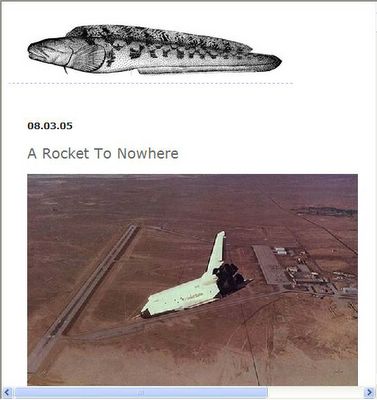
Audio: Guns & Butter with Bonnie Faulkner Air Highlights of Capitol Hill Briefings on 9/11
Guns
Interview with Jim Hoffman (about Cynthia McKinney's Truth Meeting Last Month)
Tag: 09/11/2001 Truth
Interview with Jim Hoffman (about Cynthia McKinney's Truth Meeting Last Month)
Tag: 09/11/2001 Truth
Cleric Hopes Islam Basis for Law in Iraq - Yahoo! News
Cleric Hopes Islam Basis for Law in Iraq - Yahoo! News
BG: Is this a surprise to anyone?
(you know I'm not any more anti-Islam than I am anti-Christian).
BG: Is this a surprise to anyone?
(you know I'm not any more anti-Islam than I am anti-Christian).
Survival of the Fittest, Indeed - by Charley Reese
Survival of the Fittest, Indeed - by Charley Reese
August 6, 2005
Survival of the Fittest, Indeed
by Charley Reese
We now have, just as my Confederate forefathers predicted, an imperial government in Washington. We are the only country in the world that has military forces permanently stationed all over the Earth.
All imperialism, even the American form, is ultimately based on social Darwinism, a belief not openly stated these days that we are a superior people and therefore must inevitably rule in one way or another the inferior others.
Earlier in the last century, this was openly admitted. Read this quote from Frederick Courtney Selous, a British colonialist who played a large role in establishing Rhodesia, now Zimbabwe.
"Matabeleland (a part of future Rhodesia) is doomed by what seems a law of nature to be ruled by the white man, and the black man must go, or conform to the white man's laws, or die in resisting them. ... The British colonist is but the irresponsible atom employed in carrying out a preordained law – the law which has ruled upon this planet ever since ... organic life was first evolved upon the earth – the inexorable law which Darwin has aptly termed the Survival of the Fittest."
Of course, today there is no Rhodesia, and Zimbabwe is ruled by black people, as is all of sub-Saharan Africa. The British Empire, upon which in the past the sun never set, no longer exists. What happened to the survival of the fittest?
Well, intellectuals, whether British or American, are inevitably out of touch with reality. It didn't seem to occur to them that even a person who couldn't read Latin or solve a simple equation could nevertheless wield a machete and shoot a rifle. An illiterate man can eradicate a lot of intelligence, experience and education with one 10-cent bullet. He can undo the work of years in a second. The Europeans didn't voluntarily abandon their colonies. They were driven out by people they had considered inferior.
The code word we use for superiority these days is "democracy." It is democracy that is superior to all other forms of government, and therefore we are doing people a favor to spread it while, like the British, exploiting their natural resources and cheap labor. We will eventually meet the same fate as the British. The Philippines have already kicked us out. Sooner or later, the Japanese will tell us to get out of Okinawa and other parts of Japan. Even one day the South Koreans and the Germans will say, "Go home."
And we should go home without even being asked. As long as we play the game of empire, we are both bankrupting and corrupting ourselves. No empire in the history of the world has ever lasted beyond a few centuries. While the president plays his futile fiddle tune of spreading democracy, our domestic problems multiply. The national debt piles up. Money, manpower and resources are gobbled up by the world's largest military-industrial bureaucracy.
We desperately need a president and a Congress that care to look no farther than our Pacific and Atlantic shorelines. We are neglecting our problems while trying to solve problems in other people's countries. It seems to me that the people in Washington either are so far out of touch with reality that they are ready for the booby hatch or are so corrupt that they deserve to wear orange jumpsuits. A proper foreign policy, as outlined by George Washington, deals only in state-to-state relations. It does not meddle in the internal affairs of another country. It does not take sides in its feuds and quarrels. It seeks only trade and nothing else. It avoids alliances with foreign countries. It obligates Americans to defend only themselves.
It is a national disgrace that so many thousands of Americans have died in wars that had absolutely nothing to do with the safety and security of the United States. What the imperialists in Washington are doing by abandoning the wisdom of our forefathers is proving that they are certainly not the fittest to survive.
Find this article at:
http://www.antiwar.com/reese/?articleid=6894
August 6, 2005
Survival of the Fittest, Indeed
by Charley Reese
We now have, just as my Confederate forefathers predicted, an imperial government in Washington. We are the only country in the world that has military forces permanently stationed all over the Earth.
All imperialism, even the American form, is ultimately based on social Darwinism, a belief not openly stated these days that we are a superior people and therefore must inevitably rule in one way or another the inferior others.
Earlier in the last century, this was openly admitted. Read this quote from Frederick Courtney Selous, a British colonialist who played a large role in establishing Rhodesia, now Zimbabwe.
"Matabeleland (a part of future Rhodesia) is doomed by what seems a law of nature to be ruled by the white man, and the black man must go, or conform to the white man's laws, or die in resisting them. ... The British colonist is but the irresponsible atom employed in carrying out a preordained law – the law which has ruled upon this planet ever since ... organic life was first evolved upon the earth – the inexorable law which Darwin has aptly termed the Survival of the Fittest."
Of course, today there is no Rhodesia, and Zimbabwe is ruled by black people, as is all of sub-Saharan Africa. The British Empire, upon which in the past the sun never set, no longer exists. What happened to the survival of the fittest?
Well, intellectuals, whether British or American, are inevitably out of touch with reality. It didn't seem to occur to them that even a person who couldn't read Latin or solve a simple equation could nevertheless wield a machete and shoot a rifle. An illiterate man can eradicate a lot of intelligence, experience and education with one 10-cent bullet. He can undo the work of years in a second. The Europeans didn't voluntarily abandon their colonies. They were driven out by people they had considered inferior.
The code word we use for superiority these days is "democracy." It is democracy that is superior to all other forms of government, and therefore we are doing people a favor to spread it while, like the British, exploiting their natural resources and cheap labor. We will eventually meet the same fate as the British. The Philippines have already kicked us out. Sooner or later, the Japanese will tell us to get out of Okinawa and other parts of Japan. Even one day the South Koreans and the Germans will say, "Go home."
And we should go home without even being asked. As long as we play the game of empire, we are both bankrupting and corrupting ourselves. No empire in the history of the world has ever lasted beyond a few centuries. While the president plays his futile fiddle tune of spreading democracy, our domestic problems multiply. The national debt piles up. Money, manpower and resources are gobbled up by the world's largest military-industrial bureaucracy.
We desperately need a president and a Congress that care to look no farther than our Pacific and Atlantic shorelines. We are neglecting our problems while trying to solve problems in other people's countries. It seems to me that the people in Washington either are so far out of touch with reality that they are ready for the booby hatch or are so corrupt that they deserve to wear orange jumpsuits. A proper foreign policy, as outlined by George Washington, deals only in state-to-state relations. It does not meddle in the internal affairs of another country. It does not take sides in its feuds and quarrels. It seeks only trade and nothing else. It avoids alliances with foreign countries. It obligates Americans to defend only themselves.
It is a national disgrace that so many thousands of Americans have died in wars that had absolutely nothing to do with the safety and security of the United States. What the imperialists in Washington are doing by abandoning the wisdom of our forefathers is proving that they are certainly not the fittest to survive.
Find this article at:
http://www.antiwar.com/reese/?articleid=6894
Subscribe to:
Posts (Atom)