Friday, May 20, 2005


Tomlinson used Diane Rehm interview to further distort his actions as CPB chairman

Ezra Klein: Minimum Wage Woes

Ezra Klein: Minimum Wage Woes

Crooks and Liars

Crooks and LiarsSean Hannity and The Nurses Part II/ Video

I was just emailed this short video clip of Sean Hannity coaching the two nurses that appeared on his show during the Terri Schiavo case. We reported on it April 15th.

mediabistro: FishBowlDC

mediabistro: FishBowlDC

The Counter-Recruiters: All the Charm of the Draft- And Then Some

The Counter-Recruiters: All the Charm of the Draft- And Then Some

The Huffington Post | The Blog

The Huffington Post | The Blog

Another Day in the Empire » Abu Musab al-Zarqawi in Syria: More Black Propaganda from the Bush Lie Factory

Another Day in the Empire » Abu Musab al-Zarqawi in Syria: More Black Propaganda from the Bush Lie Factory

Thursday, May 19, 2005

Blowing Up an Assumption - New York Times

Blowing Up an Assumption - New York Times The New York Times
May 18, 2005
Blowing Up an Assumption
By ROBERT A. PAPE

Chicago

MANY Americans are mystified by the recent rise in the number and the audacity of suicide attacks in Iraq. The lull in violence after January's successful elections seemed to suggest that the march of democracy was trampling the threat of terrorism. But as electoral politics is taking root, the Iraqi insurgency and suicide terrorism are actually gaining momentum. In the past two weeks, suicide attackers have killed more than 420 Iraqis working with the United States and its allies. There were 20 such incidents in 2003, nearly 50 in 2004, and they are on pace to set a new record this year.

To make sense of this apparent contradiction, one has to understand the strategic logic of suicide terrorism. Since Muslim terrorists professing religious motives have perpetrated many of the attacks, it might seem obvious that Islamic fundamentalism is the central cause, and thus the wholesale transformation of Muslim societies into secular democracies, even at the barrel of a gun, is the obvious solution. However, the presumed connection between suicide terrorism and Islamic fundamentalism is misleading, and it may spur American policies that are likely to worsen the situation.

Over the past two years, I have compiled a database of every suicide bombing and attack around the globe from 1980 through 2003 - 315 in all. This includes every episode in which at least one terrorist killed himself or herself while trying to kill others, but excludes attacks authorized by a national government (like those by North Korean agents against South Korea). The data show that there is far less of a connection between suicide terrorism and religious fundamentalism than most people think.

The leading instigator of suicide attacks is the Tamil Tigers in Sri Lanka, a Marxist-Leninist group whose members are from Hindu families but who are adamantly opposed to religion. This group committed 76 of the 315 incidents, more than Hamas (54) or Islamic Jihad (27). Even among Muslims, secular groups like the Kurdistan Workers' Party, the Popular Front for the Liberation of Palestine and the Al Aksa Martyr Brigades account for more than a third of suicide attacks.

What nearly all suicide terrorist attacks actually have in common is a specific secular and strategic goal: to compel modern democracies to withdraw military forces from territory that the terrorists consider to be their homeland. Religion is often used as a tool by terrorist organizations in recruiting and in seeking aid from abroad, but is rarely the root cause.

Three general patterns in the data support these conclusions. First, nearly all suicide terrorist attacks - 301 of the 315 in the period I studied - took place as part of organized political or military campaigns. Second, democracies are uniquely vulnerable to suicide terrorists; America, France, India, Israel, Russia, Sri Lanka and Turkey have been the targets of almost every suicide attack of the past two decades. Third, suicide terrorist campaigns are directed toward a strategic objective: from Lebanon to Israel to Sri Lanka to Kashmir to Chechnya, the sponsors of every campaign - 18 organizations in all - are seeking to establish or maintain political self-determination.

Before Israel's invasion of Lebanon in 1982, there was no Hezbollah suicide terrorist campaign against Israel; indeed, Hezbollah came into existence only after this event. Before the Sri Lankan military began moving into the Tamil homelands of the island in 1987, the Tamil Tigers did not use suicide attacks. Before the huge increase in Jewish settlers on the West Bank in the 1980's, Palestinian groups did not use suicide terrorism.

And, true to form, there had never been a documented suicide attack in Iraq until after the American invasion in 2003. Much is made of the fact that we aren't sure who the Iraqi suicide attackers are. This is not unusual in the early years of a suicide terrorist campaign. Hezbollah published most of the biographies and last testaments of its "martyrs" only after it abandoned the suicide-attack strategy in 1986, a pattern adopted by the Tamil Tigers as well.

At the moment, our best information indicates that the attackers in Iraq are Sunni Iraqis and foreign fighters, principally from Saudi Arabia. If so, this would mean that the two main sources of suicide terrorists in Iraq are from the Arab countries deemed most vulnerable to transformation by the presence of American combat troops. This is fully consistent with what we now know about the strategic logic of suicide terrorism.

Some have wondered if the rise of suicide terrorism in Iraq is really such a bad thing for American security. Is it not better to have these killers far away in Iraq rather than here in the United States? Alas, history shows otherwise. The presence of tens of thousands of American combat forces on the Arabian Peninsula after 1990 enabled Al Qaeda to recruit suicide terrorists, who in turn attacked Americans in the region (the African embassy bombings in 1998 and the attack on the destroyer Cole in 2000). The presence of nearly 150,000 American combat troops in Iraq since 2003 can only give suicide terrorism a boost, and the longer this suicide terrorist campaign continues the greater the risk of new attacks in the United States.

Understanding that suicide terrorism is mainly a response to foreign occupation rather than a product of Islamic fundamentalism has important implications for how the United States and its allies should conduct the war on terrorism. Spreading democracy across the Persian Gulf is not likely to be a panacea so long as foreign combat troops remain on the Arabian Peninsula. If not for the world's interest in Persian Gulf oil, the obvious solution might well be simply to abandon the region altogether. Isolationism, however, is not possible; America needs a new strategy that pursues our vital interest in oil but does not stimulate the rise of a new generation of suicide terrorists.

BEYOND recognizing the limits of military action and stepping up domestic security efforts, Americans would do well to recall the virtues of our traditional policy of "offshore balancing" in the Persian Gulf. During the 1970's and 1980's, the United States managed its interests there without stationing any combat soldiers on the ground, but keeping our forces close enough - either on ships or in bases near the region - to deploy in huge numbers if an emergency. This worked splendidly to defeat Iraq's aggression against Kuwait in 1990.

THE Bush administration rightly intends to start turning over the responsibility for Iraq's security to the new government and systematically withdrawing American troops. But large numbers of these soldiers should not simply be sent to Iraq's neighbors, where they will continue to enrage many in the Arab world. Keeping the peace from a discreet distance seems a better way to secure our interests in the world's key oil-producing region without provoking more terrorism.

Robert A. Pape, an associate professor of political scienceat the University of Chicago, isthe author of the forthcoming "Dying to Win: The Strategic Logic of Suicide Terrorism."

Plan Would Broaden F.B.I.'s Terror Role - New York Times

Plan Would Broaden F.B.I.'s Terror Role - New York Times The New York Times
May 19, 2005
Plan Would Broaden F.B.I.'s Terror Role
By ERIC LICHTBLAU

WASHINGTON, May 18 - The Bush administration and Senate Republican leaders are pushing a plan that would significantly expand the F.B.I.'s power to demand business records in terror investigations without obtaining approval from a judge, officials said on Wednesday.

The proposal, which is likely to be considered next week in a closed session of the Senate intelligence committee, would allow federal investigators to subpoena records from businesses and other institutions without a judge's sign-off if they declared that the material was needed as part of a foreign intelligence investigation.

The proposal, part of a broader plan to extend antiterrorism powers under the law known as the USA Patriot Act, was concluded in recent days by Republican leaders on the Senate Select Committee on Intelligence in consultation with the Bush administration, Congressional officials said.

Administration and Congressional officials who support the idea said the proposal would give the F.B.I. a much-needed tool to track leads in terrorism and espionage investigations that would be quicker and less cumbersome than existing methods. They pointed out that the administrative subpoena power being sought for the F.B.I. in terror cases was already in use in more than 300 other types of crimes, including health care fraud, child exploitation, racketeering and drug trafficking.

"Why not provide that same tool to national security investigators as well?" asked an aide to the intelligence committee who was involved in the proposal, speaking on condition of anonymity because the issue will be discussed at a closed meeting scheduled for May 26. "There wasn't really a whole lot of cogent argument against it."

But word of the proposal on Wednesday generated immediate protests from civil rights advocates, who said that it would give the F.B.I. virtually unchecked authority in terror investigations, and the plan is likely to intensify the growing debate in Congress over the balance between fighting terrorism and protecting privacy rights.

"This is a dramatic expansion of the federal government's power," said Lisa Graves, senior counsel for the American Civil Liberties Union in Washington. "It's really a power grab by the administration for the F.B.I. to secretly demand medical records, tax records, gun purchase records and all sorts of other material if they deem it relevant to an intelligence investigation."

Kevin Madden, a spokesman for the Justice Department, said department officials welcomed the intelligence committee's efforts "to support provisions that enhance law enforcement's ability to combat terrorism effectively and are particularly heartened by their support for the USA Patriot Act."

Support for the idea among many Democrats and some Republicans in Congress is uncertain, and the Senate intelligence committee's plan to push the proposal could set off a struggle with the Senate Judiciary Committee. The Judiciary Committee has joint authority for oversight of foreign intelligence surveillance law - which would be expanded under the current proposal - but its members have shown some reluctance to expand the F.B.I.'s counterterrorism powers.

A Judiciary Committee aide said that Arlen Specter, the Pennsylvania Republican who leads the Judiciary Committee, wanted to study the intelligence committee's proposal closely to determine if it was warranted. "Being a former prosecutor, he understands what tools are needed for law enforcement, but he also understands that there are serious concerns about ensuring people's liberties," said the aide, who spoke on condition of anonymity for fear of provoking tensions with the intelligence committee.

With 16 provisions of the Patriot Act set to expire at the end of the year, the Bush administration has made the permanent extension of the law one of its top legislation priorities. But critics are seeking to scale back provisions in the law that they say are vulnerable to abuse, and more than 380 governmental bodies, including seven states, have adopted formal resolutions voicing concerns about the broad reach of the law.

One provision of the law that has generated perhaps more criticism than any other is Section 215, derided by critics as the "library records" provision. It allows the F.B.I. to go to a secret intelligence court to demand access to material from businesses and other institutions as part of intelligence investigations.

The Justice Department said in a newly declassified report last month that it had used the power 35 times since late 2003 to gain information on apartment leasing, driver's licenses, financial records and other data in intelligence investigations. But it stressed that it had not used the authority to date to demand records from libraries or bookstores or to get information related to medical or gun records - all areas of concern to critics.

Democrats and civil liberties advocates said on Wednesday that they were concerned that the F.B.I.'s expanded subpoena power under the intelligence committee's proposal would render obsolete the limited safeguards under Section 215. While that provision requires the Justice Department to receive the approval of the secret intelligence court before demanding records, the administrative subpoenas under the new proposal would not.

"This all comes down to not wanting an F.B.I. agent to have to go to a prosecutor and then the court to get formal approval for a subpoena," said a Democratic Congressional official, who spoke on condition of anonymity because the intelligence committee's proposal is still considered confidential. "This becomes a substitute."

But supporters of the plan said they had built in safeguards.

The F.B.I. could only issue the demands for records with the approval of the director or senior officials down through the rank of a special agent in charge, officials said. In addition, those given subpoenas would not automatically be bound to silence unless the F.B.I. determined that disclosure could threaten national security. The Justice Department would have to report twice a year on its use of the power, and the law would be amended to specify that material must be "relevant" to a foreign intelligence investigation.

Wonkette - Remainders: Thug Life Edition

Wonkette - Remainders: Thug Life Edition

VHeadline.com - Michael Keefer: The Strange Death of American Democracy: Endgame in Ohio

VHeadline.com - Michael Keefer: The Strange Death of American Democracy: Endgame in Ohio

Frist

Wednesday, May 18, 2005

Outrage and Silence - New York Times

Outrage and Silence - New York Times
BG: not the thoughts I would express

Another Take of 09/11/2001 (oldie but goodie)

Patrick Briley -- OKC Bombing: New Revelations of Federal Criminal Conduct

Patrick Briley -- OKC Bombing: New Revelations of Federal Criminal Conduct: "OKC BOMBING: NEW REVELATIONS OF FEDERAL CRIMINAL CONDUCT"

Welcome To Terrorland' Reviews

Reviews: "'Welcome To Terrorland' Reviews


' AT THE CENTER OF the Sept. 11 legend is the man known as Mohamed Atta: ringleader and pilot of the 767 that slammed into the North Tower. Atta's sojourn in Florida in the months prior to the attacks has been woefully neglected by the dominant media. Fortunately, investigative journalist Daniel Hopsicker dug into Atta's time in Florida, and what he came up with is sordid, provocative and should put to rest once and for all any notions that Atta was any kind of Muslim, let alone a 'fanatic.' '"

BBC in Pictures

CURRY.COM: Adam Curry's Weblog

CURRY.COM: Adam Curry's Weblog: " The grandson thought about it for a minute and then asked his
grandfather: 'Which wolf wins?'

The old Cherokee simply replied, 'The one you feed.'"

The Smoking Gun Memo - by Mark Danner and Tom Engelhardt

The Smoking Gun Memo - by Mark Danner and Tom Engelhardt

Tuesday, May 17, 2005

History and Mystery - Why does the New York Times insist on calling jihadists "insurgents"? By Christopher�Hitchens

History and Mystery - Why does the New York Times insist on calling jihadists "insurgents"? By Christopher�Hitchens
BG: Hitchens isn't my fav., but this seems interesting.

May 16, 2005

The central document used against George Galloway this week by the senate committee in Washington is a forgery. Investigation by Socialist Worker shows that evidence crucial to the alleged case against the Respect MP is a fake, created after the fall of Baghdad in 2003.

Two fronts in the war on poverty - washingtonpost.com Highlights - MSNBC.com

Two fronts in the war on poverty - washingtonpost.com Highlights - MSNBC.com

ZNet |Repression | Statement on behalf of Mordechai Vanunu

ZNet |Repression | Statement on behalf of Mordechai Vanunu: "Statement on behalf of Mordechai Vanunu

......... by Daniel Ellsberg May 17, 2005
CommonDreams.org"

Latest Analysis from Pat Buchanan via Salon

Salon.com Politics: "Pat Buchanan: The right is losing


By most measures, partisans on the religious right -- sure, let's go ahead and start calling them Christianists -- ought to be feeling pretty good about themselves right now. They own the White House. They dominate Congress. Their party -- if not their particular wing of it -- controls the Supreme Court, and before long they'll have that, too.
So why is Pat Buchanan feeling so blue? In an interview in today's Washington Times, the former presidential candidate says the conservative movement has 'passed into history.' 'It doesn't exist anymore as a unifying force,' Buchanan says. 'There are still a lot of people who are conservative, but the movement is now broken up, crumbled, dismantled.'
Buchanan is unhappy with all the infighting within the Republican Party, but he's unhappier still about this: Conservatives, he says, may have lost the culture war. 'We say we won a great victory by defeating gay marriage in 11 state-ballot referenda in November,' he says. 'But I think in the long run, that will be seen as a victory in defense of a citadel that eventually fell.'
What's most interesting about Buchanan's comments, however, is the reason he offers for the right's 'loss.' It's not that the media or liberal politicians or God knows who else is overpowering the will of the American people; it's that a majority of Americans simply don't agree with the Christianist agenda. Moderate Republican leaders, Buchanan says, are 'indifferent' to the moral issues that matter to religious Republicans 'because they see them -- and correctly -- as no longer popular, no longer the majority positions that they used to be.'
-- Tim Grieve "

ZNet |Colombia | Plan Colombia Collapse?

ZNet |Colombia | Plan Colombia Collapse?: "Plan Colombia Collapse? "

Keeping Hunter Thompson's death alive

Keeping Hunter Thompson's death alive
BG: I think the Gannon/Gucket mention as being related to Johnny Gosch is discrediting, but I could be wrong. I agree something doesn't wash with the sheriff's report and other reported facts.

BG: Interesting...

First the Bad News

If you do a yahoo search with terms:
conspiracy of 09/11/2001
You don't get very much useful info.


You do get, however, bgtruth.blogspot.com as the number 5 ranking.

The Truth Seeker - Respected Scholarly Journal Exposes 911

The Truth Seeker - Respected Scholarly Journal Exposes 911

Newsweek / Koran story: The resignation of Scott McClellan - Bloggermann - MSNBC.com

The resignation of Scott McClellan - Bloggermann - MSNBC.com
BG: Olbermann sees the ugliness, and .... decides McCellan should resign. How does getting another equally dishonest Press Secretary help the situation?

Link to Video (Olbermann Show / Interview with Author)

More from Alex Jones... (I actually believe most of this stuff.)

Monday, May 16, 2005

Staying What Course? - New York Times

Staying What Course? - New York Times

--------------------------------------------------------------------------------

May 16, 2005
Staying What Course?
By PAUL KRUGMAN
Is there any point, now that November's election is behind us, in revisiting the history of the Iraq war? Yes: any path out of the quagmire will be blocked by people who call their opponents weak on national security, and portray themselves as tough guys who will keep America safe. So it's important to understand how the tough guys made America weak.

There has been notably little U.S. coverage of the "Downing Street memo" - actually the minutes of a British prime minister's meeting on July 23, 2002, during which officials reported on talks with the Bush administration about Iraq. But the memo, which was leaked to The Times of London during the British election campaign, confirms what apologists for the war have always denied: the Bush administration cooked up a case for a war it wanted.

Here's a sample: "Military action was now seen as inevitable. Bush wanted to remove Saddam, through military action, justified by the conjunction of terrorism and W.M.D. But the intelligence and facts were being fixed around the policy."

(You can read the whole thing at www.downingstreetmemo.com.)

Why did the administration want to invade Iraq, when, as the memo noted, "the case was thin" and Saddam's "W.M.D. capability was less than that of Libya, North Korea, or Iran"? Iraq was perceived as a soft target; a quick victory there, its domestic political advantages aside, could serve as a demonstration of American military might, one that would shock and awe the world.

But the Iraq war has, instead, demonstrated the limits of American power, and emboldened our potential enemies. Why should Kim Jong Il fear us, when we can't even secure the road from Baghdad to the airport?

At this point, the echoes of Vietnam are unmistakable. Reports from the recent offensive near the Syrian border sound just like those from a 1960's search-and-destroy mission, body count and all. Stories filed by reporters actually with the troops suggest that the insurgents, forewarned, mostly melted away, accepting battle only where and when they chose.

Meanwhile, America's strategic position is steadily deteriorating.

Next year, reports Jane's Defense Industry, the United States will spend as much on defense as the rest of the world combined. Yet the Pentagon now admits that our military is having severe trouble attracting recruits, and would have difficulty dealing with potential foes - those that, unlike Saddam's Iraq, might pose a real threat.

In other words, the people who got us into Iraq have done exactly what they falsely accused Bill Clinton of doing: they have stripped America of its capacity to respond to real threats.

So what's the plan?

The people who sold us this war continue to insist that success is just around the corner, and that things would be fine if the media would just stop reporting bad news. But the administration has declared victory in Iraq at least four times. January's election, it seems, was yet another turning point that wasn't.

Yet it's very hard to discuss getting out. Even most of those who vehemently opposed the war say that we have to stay on in Iraq now that we're there.

In effect, America has been taken hostage. Nobody wants to take responsibility for the terrible scenes that will surely unfold if we leave (even though terrible scenes are unfolding while we're there). Nobody wants to tell the grieving parents of American soldiers that their children died in vain. And nobody wants to be accused, by an administration always ready to impugn other people's patriotism, of stabbing the troops in the back.

But the American military isn't just bogged down in Iraq; it's deteriorating under the strain. We may already be in real danger: what threats, exactly, can we make against the North Koreans? That John Bolton will yell at them? And every year that the war goes on, our military gets weaker.

So we need to get beyond the clichés - please, no more "pottery barn principles" or "staying the course." I'm not advocating an immediate pullout, but we have to tell the Iraqi government that our stay is time-limited, and that it has to find a way to take care of itself. The point is that something has to give. We either need a much bigger army - which means a draft - or we need to find a way out of Iraq.

E-mail: krugman@nytimes.com


Copyright 2005 The New York Times Company Home Privacy Policy Search Corrections RSS Help Contact Us Back to Top

I-BAT - 001

I-BAT - 001: "Research into 9/11 planning and a possible sequel, suggests that Maurice Strong and fellow insiders at Power Corp, Montreal, are laundering UN oil-for-food money through off-book partners, including French banks and oil, water and arms traders"

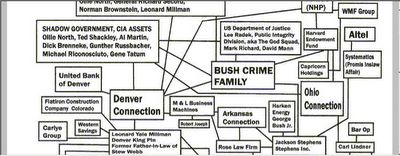
BG: Bush Crime Family?

Mary Schneider

Mary SchneiderWhistleblower Documents - Who Knew What And When

Meet the Poor Republicans - New York Times

Link to Good Discussion by Kevin Drum

Meet the Poor Republicans - New York Times: "May 15, 2005
Meet the Poor Republicans
By DAVID BROOKS

Last week the Pew Research Center came out with a study of the American electorate that crystallized something I've been sensing for a long time: rich people are boring, but poor people are interesting."

BG: I had no idea where Brooks was going with this, but I was fairly sure I would find his discussion putrid. I was not disappointed.

Sunday, May 15, 2005

Don't give in to sweet temptations - Nutrition Notes - MSNBC.com

Don't give in to sweet temptations - Nutrition Notes - MSNBC.com

Moderation can be difficult when it comes to sugary treatsBy Karen Collins, R.D.
Registered Dietitian
Special to MSNBC.com
Updated: 11:49 a.m. ET May 13, 2005Chocolate, bakery, soft drinks and other sweets are available around the clock. Their constant availability can make eating moderate amounts of them difficult.
advertisement

Although complete avoidance of sweets is unnecessary for good health, the calories in sweets add up quickly, making weight control more difficult. Sweets can also replace nutritious foods that have vitamins, fiber, phytochemicals and other substances vital to our well-being.
Part of the problem with sweets is that setting reasonable limits can be confusing. Some experts suggest that no more than ten percent of our calories should come from added sugars. Added sugars means sweeteners like table sugar, high fructose corn syrup and honey, not the natural sugars in fruits and milk, for example.
According to these experts, a reasonable amount of added sugars would vary with a person�s calorie needs. Adults who are sedentary or trying to lose weight might limit themselves to 160 to 180 calories of added sugar (40�45 grams) per day.
This amount could be a 12-ounce regular soft drink or 2 cookies and a cup of ice cream, as long as few other sweetened foods, like jelly or sugary cereals were not eaten during the day. Moderately active people who want to maintain their weight, might have 200�240 calories of added sugar (50�60 grams). These people could enjoy a small candy bar and six small cookies, for instance, but sugar in a 12-ounce regular soft drink adds up quickly and leaves room for little else.

Watch the snacking

Just by identifying undamaged parts from the damaged engine positive identification of the engine was made in the article : However, the engine identified, a CFM56, is the primary engine of the Boeing 737 not the Boeing 767 alleged to have struck the South Tower

WING - Trashing The Truth

WING - Trashing The Truth
BG: These postings are terribly confused (intentionally?) and off-base I think. Wingtv is subject to vendettas for sure, but don't throw the baby out with the bath water....

Email that I received from Veterans Support Group

News on Veterans for Common Sense today:
Afghanistan riddled with drug tiesThe case of an Afghan village police chief, named Inayatullah, is a small example of a much larger problem. Is Commander Inayatullah a courageous law-and-order crusader responsible for smashing the drug mafia in his hamlet? Or, is he an opium smuggler? Or, as his bosses say, is he both?
Lawless Iraq is 'key drug route'Drug smugglers exploiting internal chaos in Iraq have turned the country into a transit route for Afghan heroin, an influential drug agency says.
U.S. Soldiers, Law Officers Snared in Border Drug StingA brazen conspiracy among U.S. law enforcement officers and soldiers to smuggle cocaine from Mexico was disclosed Thursday by the Justice Department, adding to concerns that public corruption north of the border was growing.
Law Protecting Soldiers Undermines War on TerrorWhat happens to U.S. soldiers who are charged with aiding and abetting an international terrorist organization?
U.S. army probes why troops go wild in ColombiaThe U.S. military is investigating what has gone wrong with its operations in Colombia, where troops have been arrested on suspicion of smuggling drugs and selling arms to far-right militias, a senior U.S. officer said on Wednesday.
Pentagon's war stories leave a legacy of doubtGiven that we now know what really happened in the death of Pat Tillman in Afghanistan, is it any wonder the Italians dispute the U.S. government's version of how Nicola Calipari died in Iraq?
Veterans for Common Sense needs your supportConsider making a gift today. Every dollar helps support our work on national securty, civil liberties and human rights, veterans issues and U.S. energy independence. Click here to make a gift today. Please visit Veterans for Common Sense at www.veteransforcommonsense.org

"Review: Freakonomics, by Steven Levitt & Stephen Dubner" from The Intuitive Life Business Blog

"Review: Freakonomics, by Steven Levitt & Stephen Dubner" from The Intuitive Life Business Blog

Left Denial on 9/11 Turns Irrational
by Jack Straw Friday, May. 06, 2005 at 3:42 PM

People like Noam Chomsky and Ward Churchill are turning toward the irrational as they continue to deny increasing signs that 9/11 was an inside job.
Technorati Tags: sept11 Chomsky Churchill

ESR | May 9, 2005 | Barney Frank and the law of unintended consequences

ESR | May 9, 2005 | Barney Frank and the law of unintended consequences
BG: You, Chuck Morse, are an ass.

Gagged, But Not Dead

Technorati Tags: sept11 sibel edmonds Ashcroft DOJ FBI translation coverup
Gagged, But Not Dead
By Sibel Edmonds

The Appeal Court’s decision on Sibel Edmonds’ Case is out: ‘Case Dismissed;’ no opinion cited; no reason provided. The Court’s decision, issued on Friday, May 6, has generated a string of obituaries; “another major blow, maybe the last one, to Sibel Edmonds, a woman who has faced an unprecedented level of government secrecy, gag orders, and classification.” Well, dear friends and supporters, Sibel Edmonds may be gagged, but she’s not dead.

On October 18, 2002; three months after I filed my suit against the Department of Justice for unlawful termination of my employment caused by my reporting criminal activities committed by government officials and employees, John Ashcroft, the then Attorney General, invoked a rarely invoked privilege, the State Secrets Privilege. According to Ashcroft, everything involving my case and my allegations were considered state secrets, and whether or not I was right in my allegations, the United States District Court had to dismiss my entire case without any questions, hearings or oral argument; period. According to Ashcroft, the court had to grant his order and dismiss the entire case with no hearings solely based on the fact that he, Ashcroft, said so. After all, our government knew best. As of that day, my case came to be gagged; but I continued on.


In April 2004, after attorneys for a large group of 9/11 family members subpoenaed my deposition, the then Attorney General, John Ashcroft, made his next move: He invoked the state secrets privilege for the second time, and this time, he designated my place of birth, date of birth, my mother tongue, my father tongue, my university background, and my previous employments all State Secrets, Top Secret Classified, and matters of the highest level national security. Let’s see, based on this new ruling and designation by our ironically named Justice Department, my passport w"

KRT Wire | 05/12/2005 | So much for national security in the public interest

KRT Wire | 05/12/2005 | So much for national security in the public interest: "Posted on Thu, May. 12, 2005
Click here to find out more!

So much for national security in the public interest"

Galloway hounded by AIPAC cell within U.S. Congress; Bolton tied to same cell

Galloway hounded by AIPAC cell within U.S. Congress; Bolton tied to same cell: "Bolton had on his staff a 'special adviser' named Matthew Freedman who pulled down a $110,000 per annum salary. Freedman is also a lobbyist who represents 'private clients.' He refused to tell the Senate Foreign Relations Committee who those clients were. However, it has been discovered that Freedman, a long time GOP operative like Bolton, is tied to the same oil industry network that once used Vice President Cheney and Secretary of State Condoleezza Rice as agents of influence."

Teens seek debate vs. Limbaugh

Teens seek debate vs. LimbaughBG: Limbaugh hot air rarely gets called out for what it is... this is great!

Demand WTC 911 Truth : Contact Form To Write State Representative In Congress

Demand WTC 911 Truth : Contact Form To Write State Representative In Congress

Saturday, May 14, 2005


The Nobility of Slaughter Tom Friedman, the Imperial Chronicler By MIKE WHITNEY

'Un-Journalism' at the New�Yorker by Jude Wanniski

'Un-Journalism' at the New�Yorker by Jude Wanniski

Letters to Woodward. Breaking Through The News Blackout in the US :: from www.uruknet.info :: news from occupied Iraq - it

Letters to Woodward. Breaking Through The News Blackout in the US :: from www.uruknet.info :: news from occupied Iraq - it

Uzbekistan Chaos

BlondeSense: The Part You Haven’t Heard

BlondeSense: The Part You Haven’t HeardDahr Jamail's Iraq Dispatches

LINK TO PDF OF New Republic Mag. in PDF form (5/23)

BG: They had the ridiculous article in Pop. Mechanics, they are planning a piece in SciAmerican, and here we have this supposed scholarly piece that is just so much pettifogery.

U.S. sends new Qaeda evidence for German 9/11 case

Top News Article | Reuters.com

Iraq, the secret US visit, and an angry military chief :: from www.uruknet.info :: news from occupied Iraq - it

Iraq, the secret US visit, and an angry military chief :: from www.uruknet.info :: news from occupied Iraq - it

News Hounds: Fox News Blames Democrats for the Crash Reps Suffered in Polls after Schiavo

News Hounds: Fox News Blames Democrats for the Crash Reps Suffered in Polls after Schiavo

Fun Pics from ABC

As O'Reilly let CPB's Tomlinson deny White Hous ... [Media Matters for America]

As O'Reilly let CPB's Tomlinson deny White Hous ... [Media Matters for America]

O'Reilly admitted "misquoting" Houston Chronicl ... [Media Matters for America]

O'Reilly admitted "misquoting" Houston Chronicl ... [Media Matters for America]

BBC Fun Pics

The Common Ills: NYT: J-Ass's half baked cases continue to bubble up long after Ashcroft is gone

The Common Ills: NYT: J-Ass's half baked cases continue to bubble up long after Ashcroft is gone

Monday, May 09, 2005


Home from Iraq
Journalist urges Americans to search for truth, freedom'

ABOUT THIS SPEECH This article is adapted from a speech given by photojournalist Molly Bingham at Western Kentucky University last month. Bingham, a Louisville native, was detained in 2003 by Iraqi security forces and held in Abu Ghraib prison from March 25 to April 2, 2003. Eighteen days after her release, she returned to Iraq to pursue stories for The New York Times, The Guardian of London and others. Taking a short break during the summer of 2003, Bingham had the idea of working on a story to explore who was involved in the nascent resistance that was becoming apparent throughout Iraq. She scanned the papers that summer, looking for an article that would show some journalist had reported the story, had gone deeper to find out the source of the new violence. No one had. So in August 2003, Bingham returned with British journalist Steve Connors and spent the next 10 months reporting the story of the Iraqi resistance. Her account was published in Vanity Fair magazine in July 2004; Connors shot a documentary film on the subject. This speech was a challenge to journalists, and Americans, to speak up and be sure their comments, questions and thoughts are heard, and that the First Amendment is celebrated in all its strengths. Bingham began her career as a photo intern for The Courier-Journal and Louisville Times.
U.S. soldiers at the infamous Abu Ghraib prison near Baghdad. Covering the war is difficult -- whether the subject is the U.S. or Iraqis. (BY ANTONIO SCORZA, GETTY IMAGES)

.gcitopjobs a:link {font-family: verdana, sans-serif; font-size: 10px; text-decoration: none; color: #000099} .gcitopjobs a:visited {font-family: verdana, sans-serif; font-size: 10px; text-decoration: none; color: #000099} .gcitopjobs a:active {font-family: verdana, sans-serif; font-size: 10px; text-decoration: none; color: #990000} .gcitopjobs a:hover {font-family: verdana, sans-serif; font-size: 10px; text-decoration: none; color: #990000}

DriversHAPPY DRIVERS=HAPPY FAMILIESSUMMITT TRUC...
General Help WantedHigh quality printer for the entertainme...
SalesSALES MANAGER, BUILDING PRODUCTS Holm In...
Accounting/ Finance/ BankingLOAN OFFICER (AUTO) Crescent Bank Trust ...
WINDOW INSTALLERSRenewal By Andersen
OtherMILLER PIPELINE CORPORATION Founded in 1...
All Top Jobs
About Top Jobs
We spent 10 months in Iraq, working on a story, understanding who the people are who are fighting, why they fight, what their fundamental beliefs are, when they started, what kinds of backgrounds they come from, what education, jobs they have. Were they former military, are they Iraqi or foreign? Are they part of al-Qaida? What we came up with is a story in itself, and one that Vanity Fair ran in July 2004 with my text and pictures. [My colleague Steve Connors] shot a documentary film that is still waiting to find a home. But the basic point for this discussion is that we both thought it was really journalistically important to understand who it was who was resisting the presence of the foreign troops. If you didn't understand that, how could you report what was clearly becoming an "ongoing conflict?" And if you were reading the news in America, or Europe, how could you understand the full context of what was unfolding if what motivates the "other side" of the conflict is not understood, or even discussed?
Just the process of working on that story has revealed many things to me about my own country. I'd like to share some of them with you:
Lesson One: Many journalists in Iraq could not, or would not, check their nationality or their own perspective at the door.
One of the hardest things about working on this story for me personally, and as a journalist, was to set my "American self" and perspective aside. It was an ongoing challenge to listen open-mindedly to a group of people whose foundation of belief is significantly different from mine, and one I found I often strongly disagreed with.
But going in to report a story with a pile of prejudices is no way to do a story justice, or to do it fairly, and that constant necessity to bite my tongue, wipe the smirk off my face or continue to listen through a racial or religious diatribe that I found appalling was a skill I had to practice. We would never walk in to cover a union problem or political event without seeking to understand the perspective from both, or the many sides of the story that exist. Why should we as journalists do it in Iraq?
Lesson Two: Our behavior as journalists has taught us very little. Just as in the lead up to the war in Iraq, questioning our government's decisions and claims and what it seeks to achieve is criticized as unpatriotic.
Along these lines, the other thing I found difficult was the realization that, while I was out doing what I believe is solid journalism, there were many (journalists and normal folks alike) who would question my patriotism, or wonder how I could even think hearing and relating the perspective "from the other side" was important.
Certainly, over the last three years I've had to acquire the discipline of overriding my emotional attachment to my country, and remember my sense of human values that transcend frontiers and ethnicity. And with a sense of duty to history, I needed to just get on with reporting the story. My value of human life and rights don't fluctuate depending on which country I'm in. I don't see one individual as more deserving of fair treatment than another. . . .
Now, I realize I'm in Kentucky, a state with many military connections, and there are many of you here who may have served, or have family members who serve, and let me take this moment to say that I have the utmost respect and sympathy for the American soldiers overseas right now, particularly in Iraq. They have been sent on a most difficult mission, to quell a population that will not be quelled, in a land awash with weapons. The American military is being used to find a solution to what is essentially a political problem, an equation that rarely adds up well. As if that were not enough, our soldiers have been sent with insufficient resources to protect themselves. In my mind, that is all inexcusable.
Lesson Three: To seek to understand and represent to an American audience the reasons behind the Iraqi opposition is practically treasonous.
Every one of the people involved in the resistance that we spoke to held us individually responsible for their security. If something happened to them -- never mind that they were legitimate targets for the U.S. military -- they would blame us. And kill us. We soon learned that they had the U.S. bases so well watched that we had to abandon our idea of working on the U.S. side of the story -- that is, discovering what the soldiers really thought about who might be attacking them. There were so many journalists working with the American soldiers that we believed that that story would be well told. More practically, if we were seen by the Iraqis going in and out of the American bases, we would be tagged immediately as spies, informants and most likely be killed.
As terrifying as that was to manage and work through, there was another fear that was just as bad. What if the American military or intelligence found out what we were working on? Would they tail us and round up the people we met? Would they kick down our door late one night, rifle through all our stuff and arrest us for "collaborating with the enemy?" Bear in mind that there are no real laws in Iraq. At the time that we were working, the American military was the law, and it seemed to me that they were pretty much making it up as they went along. I was pretty sure that if they wanted to "disappear" us, rough us up or even send us for an all expenses paid vacation in Guantánamo for suspected al-Qaida connections, they could do so with very little, or even no recourse on our part.
I could go into a long litany of the ways in which the American military has treated journalists in Iraq. Recent actions indicate that the U.S. military will detain and/or kill any journalist who happens to be caught covering the Iraqi side of the militant resistance, and indeed a number of journalists have been killed by U.S. troops while working in Iraq. This behavior at the moment seems to be limited to journalists who also happen to be Arabs, or Arab-looking, but that is only a tangential story to what I'm telling you about here.
The intimidation to not work on this story was evident. Dexter Filkins, who writes for The New York Times, related a conversation he had in Iraq with an American military commander just before we left. Dexter and the commander had gotten quite friendly, meeting up sporadically for a beer and a chat. Towards the end of one of their conversations, Dexter declined an invitation for the next day by explaining that he'd lined up a meeting with a "resistance guy." The commander's face went stony cold and he said, "We have a position on that." For Dexter the message was clear. He cancelled the appointment. And, again, this is not meant as any criticism of the military; they have a war to win, and dominating the "message," or the news is an integral part of that war. The military has a name for it, "information operations," and the aim is to achieve information superiority in the same way they would seek to achieve air superiority. If you look closely, you will notice there is very little, maybe even no direct reporting on the resistance in Iraq. We do, however, as journalists report what the Americans say about the resistance. Is this really anything more than stenography?
And many American journalists often refer to those attacking Americans or Iraqi troops and policemen as "terrorists." Some are indeed using terrorist tactics, but calling them "terrorists" simply shuts down any sense of need or interest to look beyond that word, to understand why indeed human beings might be willing to die in a violent struggle to achieve their goal. Pushing them off as simply "insane, wild Arabs" or "extremist Muslims" does them no service, but even more, it does the U.S. no service. If we as Americans fail to understand who attacks us and why, we will simply continue on this same path, and continue watching from afar as a war we don't understand boils over.
Lesson Four: The gatekeepers -- by which I mean the editors, publishers and business sides of the media -- don't want their paper or their outlet to reveal that compelling narrative of why anyone would oppose the presence of American troops on their soil. Why would anyone refuse democracy? Why would anyone not want the helping hand of America in overthrowing their terrible dictator? It's amazing to me how expeditiously we turn away from our own history. Think of our revolution. Think of our Founding Fathers. Think of what they stood for and hoped for. Think of how, over time, we have learned to improve on our own Constitution and governance. But think, mostly, about the words I just used: It was our decision and our determination that brought us where we are now.
Recall Patrick Henry's famous speech encouraging the Second Virginia Convention, gathered on March 20, 1775, to fight the British, "Give me liberty or give me death!" Why is it that we, as Americans, presume that any Iraqi would feel any differently? If the roles were reversed, do you think for a moment that our men wouldn't be stockpiling arms and attacking any foreign invader with the temerity to set foot on our soil, occupy our buildings of government and write us a new constitution?
Wouldn't we as women be joining with them in any way we could? Wouldn't the divisions between us -- how we feel about President Bush, whether we're Republican or Democrat -- be put aside as we resisted a common enemy?
Then why is it that this story of human effort for self-determination by violent means cannot be told in America? Are we so small, so confused by our own values that we cannot recognize when someone emulates our own struggle? Even if it is the U.S. that they are struggling against? I want to be careful to explain that I am not saying that the Iraqis fighting against us are necessarily fighting for democracy, but they are fighting for their right to decide for themselves what their nation looks like politically.
Lesson Five: What it's like to be afraid of your own country.
Once the story was finished and set to come out on the street, I was rushing back to the States -- mostly because we could no longer work once the story was published -- and I found I was scared returning to my own country. And that was an amazingly strange and awful feeling to have. Again, you could call me paranoid, but the questions about what might happen to me once in America -- where at least I would have more rights -- kept racing through my brain. I'm still here, so you could say that my frantic mental gymnastics about what could happen to me in my own country were paranoid anxieties.
But I would turn that question around:
How many other American journalists, perhaps not as secure in their position as I, have thought to do a story and decided that it's too close to the bone, too questioning of the American government or its actions? How many times was the risk that our own government might come in and rifle through our apartment, our homes or take us away for questioning in front of our children a factor in our decision not to do a story? How many times did we as journalists decide not to do a story because we thought it might get us into trouble? Or, as likely, how often did the editor above us kill the story for the same reasons? Lots of column inches have been spent in the discussion of how our rights as Americans are being surreptitiously confiscated, but what about our complicity, as journalists, in that? It seems to me that the assault on free speech, while the fear and intimidation is in the air, comes as much from us -- as individuals and networks of journalists who censor ourselves -- as it does from any other source.
We need to wake up as individuals and as a community of journalists and start asking the hard and scary questions. Questions we may not really want to know the answers to about ourselves, about our government, about what is being done in our name, and hold the responsible individuals accountable through due process in our legal or electoral system.
We need to begin to be able to look again at our government, our leadership and ourselves critically. That is what the Fourth Estate is all about. That's what American journalism can do at its zenith. I also happen to believe that, in fact, that is the highest form of patriotism -- expecting our country to live up to the promises it makes and the values it purports to hold. The role of the media in assisting the public to ensure those values are reflected in reality is undeniably failing today.
Go ahead, take a hard look in the mirror, ask the questions -- if there is something in our nation that needs repair or change, that is how it will get done, by asking those questions, getting answers and reporting them.
We still have the freedom in this country as individuals and as journalists to defend the rights enshrined in the Constitution, to defend the values that we as individuals still hold dear -- so why aren't we doing it? Are we scared? If we're scared, then who will be there to defend those rights and values when it is proposed that they be taken away?
I still believe in that country that I love so dearly, the place I think of when the words "freedom," "opportunity," "liberty," "justice" and "equality" are spoken on lips, but I want it to be a country I see, hear and feel every day, not one that lives in my imagination.
It's time we looked in the mirror and began to take responsibility for what our country looks like, what our country is and how it behaves, rather than acting like victims before we actually are.
Or do I need to start facing the reality that all I love and believe in is simply self-delusion?

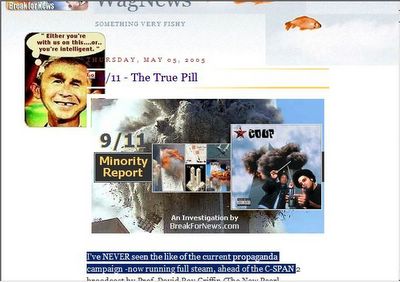
I've NEVER seen the like of the current propaganda campaign -now running full steam, ahead of the C-SPAN

Makow - Bankers Are Behind The Counter Culture The Aquarian Conspiracy

Makow - Bankers Are Behind The Counter Culture The Aquarian Conspiracy

BG: This is mostly Bullsh*t (accoring to me of course). I wouldn't have read the article if I had seen the Author (Makow) before clicking the link. Still, it's interesting to see how major pillars of Religion, Anti-feminist, are used to construct an explanation of where the true evil lies.

Natural Petroleum - NO Connection With Biological Matter

Natural Petroleum - NO Connection With Biological Matter
BG: This seems like the right answer to me. (There are a lot of people such as Ruppert in the 911 Truth Moment who think oil is tied to organic decay.)

The Observer | International | Soldier lifts lid on Camp Delta

The Observer | International | Soldier lifts lid on Camp Delta

The Truth Seeker - Voice of the White House � May 4, 2005 Gannon Guckett

The Truth Seeker - Voice of the White House � May 4, 2005I will then discuss the matter of the greatest breach of U.S. national security since Jonathan Pollard’s escapades in giving a boxcar full of vital secrets to Israel.

FPI 2005: N.C. federal judge appointed to America's 'Secret Court'

FPI 2005: N.C. federal judge appointed to America's 'Secret Court'

US-UK-Italian Uranium Science Fraudulent: Patients Betrayed by Italian Scientist :: from www.uruknet.info :: news from occupied Iraq - ch

US-UK-Italian Uranium Science Fraudulent: Patients Betrayed by Italian Scientist :: from www.uruknet.info :: news from occupied Iraq - ch

Sunday, May 08, 2005


As it turns out, the “Al-Qaeda kingpin” Faraj al-Libbi is a nobody in the illusory world of al-Qaeda terrorism, according to a story in the Sunday Times today

Bush, Blair and the Osama Tapes, If the Moon could talk, what would it say?

Bush, Blair and the Osama Tapes, If the Moon could talk, what would it say?

An accused Islamic militant who says he is simply a martial arts and physical education instructor burst into tears Wednesday as he denied belonging to a terrorist cell that allegedly helped plot the Sept. 11 attacks.

Secret British Memo Confirms WMD Lie

Bush Administration Claims Presidential Privilege for LBJ Documents

Bush Administration Claims Presidential Privilege for LBJ Documents

The Common Ills: This morning's New York Times, Bolton, Sibel Edmonds, Microsoft

The Common Ills: This morning's New York Times, Bolton, Sibel Edmonds, Microsoft

BuzzFlash GOP Hypocrite of the Week: Elaine L. Chao

BuzzFlash GOP Hypocrite of the Week: Elaine L. Chao

Another Day in the Empire � Is Abu Faraj al-Libbi a Musharraf Patsy?

Another Day in the Empire � Is Abu Faraj al-Libbi a Musharraf Patsy?

May 07, 2005: Cheney and Bolton

The Washington Note Archives

Saturday, May 07, 2005

Court Allows Government to Use Secrecy to Avoid Accountability :: 9/11 CitizensWatch :: We are concerned citizens challenging the official story of 9/11

Court Allows Government to Use Secrecy to Avoid Accountability :: 9/11 CitizensWatch :: We are concerned citizens challenging the official story of 9/11

Uncovering the past or how I got my degree in political archeology :: from www.uruknet.info :: news from occupied Iraq - it

Uncovering the past or how I got my degree in political archeology :: from www.uruknet.info :: news from occupied Iraq - it

The MadCow Morning News: An Introduction to Secret History

The MadCow Morning NewsAn Introduction to Secret History

Iraq causing big trouble for Pentagon :: from www.uruknet.info :: news from occupied Iraq - it

Iraq causing big trouble for Pentagon :: from www.uruknet.info :: news from occupied Iraq - it

Robert C. Koehler | Common Wonders, Citizens in the rain

Robert C. Koehler | Common Wonders

Friday, May 06, 2005

WagNews: The Slow Poisoning of America

WagNews: The Slow Poisoning of America

WagNews: You Can See The Propaganda Coming....

WagNews: You Can See The Propaganda Coming....

Oklahoma City Bomber Nichols Says a Third Man Took Part in Plot

Oklahoma City Bomber Nichols Says a Third Man Took Part in Plot

CNN Reporter Mentions 'Implosion' On 9/11/2001

THE BRAD BLOG: "Tribune Syndicate Spikes Robert Koehler's Latest Column!"

THE BRAD BLOG: "Tribune Syndicate Spikes Robert Koehler's Latest Column!"

TOTAL 911 INFO: Scientific American Hit Piece?

TOTAL 911 INFOBG: Sad News
Technorati Tag: sept11

Andrew Tobias - Money and Other Subjects

Andrew Tobias - Money and Other Subjects

Major WTC Insurance Company Questions Building 7 Collapse As Potential Fraud

Major WTC Insurance Company Questions Building 7 Collapse As Potential Fraud: "Major WTC Insurance Company Questions Building 7 Collapse As Potential Fraud"

Monday, May 02, 2005

Original Poster Request that I Provide That LINK
http://www.911blogger.com/2005/04/proper-release-of-griffin-in-madison.html


David Ray Griffin in Madison, WI on 4/18/2005
Video Link: http://911blogger.fileburst.com/videos/griffin_madison_full_150.avi
Very Large File... 150 Megabytes... smaller file available at link at beginning of this post.
Technorati Tag: sept11